|
|
|
|
|
Society News Pages
1
2
3 |
|
E-mail this page to your
friends |
Black Tie
International:
The
International Day of the African Child-
The Incidence of the Female Soldier and the International
Criminal Court
|
|
 |
|
Fatou Bensouda, Incoming Prosecuter Elect,
International Criminal Court,
The Hague
MS. Ugoji Adanma Eze, Esq. President and CEO, Eng Aja Eze
Foundation.
Patrick Mc Caffrey, Chairman & co-Founder, Brabham &
Associate Ltd,
Jarmo Viinanen, Ambassador, Permanent Representative of
Finland
to the United Nations |
|
The
International Day of the African Child
"The Incidence of the Female Soldier and the International
Criminal Court"
Photos by:
Blacktiemagazine/GMK
Article by: Ugoji Adanma Eze Esq All rights
Reserved @2012
The International Day of the African Child: The Female
Child Soldier and the ICC
“ It is our strong belief that justice cannot be done in or
out of the courtroom if the voices of female Child Soldiers
are not heard.”
“…the crimes committed towards female child soldiers need to
be analyzed specifically. Our focus should shift from”
children with arms” to children who are affected by arms”
“In the context of crime of enlisting and conscripting child
soldiers.I as the new Prosecutor of the ICC, will make sure
that such crimes and victims will no longer be ignored and
perpetrators will face justice.”
Ms.Fatou Bensouda, Incoming Prosecutor Elect speaking at the
International Day of the African Child: Female Child Soldier
and
the International Criminal Court”
“Finland’s human rights policy has for a long time had a
specific focus on the rights of the Child. Girls affected by
armed conflict are amongst the most vulnerable children and
therefore the promotion and protection of their rights
deserves our concerted support.”
H.E.Mr. Jarmo Viiananen, Ambassador and Permanent
Representative of Finland to the United Nations speaking at
the International Day of the African Child: The Incidence of
the Female Child Soldier and the ICC”
“ There is a need to invest in building or restoring the
capacity of these systems in states in the midst of or
emerging from conflict. With such support these systems may
be more likely to overcome challenges in prosecuting these
crimes such as lack of political will or lack of ability due
to limited resources or being in
a state of disorder.”
H.E.Mrs Josephine Ojiambo, Deputy Permanent Representative
of The Republic of Kenya to the United Nations.
The Engr. Aja Eze Foundation hosted in collaboration with
the Permanent Mission of Finland to the United Nations and
the American Society of International Lawyers on the 4th of
June 2012 the International Day of the African Child.
‘”The Incidence of the Female Child Soldier and
the International Criminal Court”
The CEO and Founder of the Eng Aja Eze Foundation decided to
focus on the Female child soldier because she felt that they
are the invisible and most vulnerable groups during
conflict.
The Incoming Prosecutor Elect Ms Fatou Bensouda laid out in
a most compelling manner what her plans were as regards this
phenomena.
Ms Bensouda pointed out quite rightly that one of the most
fundamental aspects of the crime of utilizing child soldiers
in armed conflict is the gender aspect. She also said that
it is estimated that there are 250,000 Child Soldiers in the
world and also that of these 40% are children.
Reference was made to the fact that UNICEF’s submission on
reparations to the judges in the Lubanga Case that numerous
girls who had been through these atrocities try to keep
their pats hidden to avoid stigmatization in their
communities. The long term effect of this is that it
prevents victims from being taken into account in the
healing process. It also creates prevents the difficulties
in ending impunity for the perpetrators.
The Incoming perpetrator also stated that there is a
pressing need to focus on this phenomena due to the example
of what occurred in Sierra Leone.
The DDR which were performed in the aftermath of the armed
conflict ,were not designed with a specific focus on girl
soldiers; as the programs often required the child soldiers
to hand in a weapon, a process which clearly excluded the
female child soldiers as they did not often carry guns.
According to UNICEF, at the end of the disarmament and
demobilization in Sierra Leone, 6,845 children, of which
just 547 were girls. However a substantial amount of the
girls were not included in the counting nor in the DDR
program itself. This lack of focus thus results in the lack
of female participation in official reintegration programs,
a direct consequence of which is that numerous former female
combatants are often left with no support when they leave
the armed forces and find themselves in a situation where
they are trading sex for food, shelter or money merely to
survive.
The incoming Prosecutor elect then spoke at great lengths of
the recent international developments in this sphere and how
the Office of the Prosecutor of the ICC has been working to
ensure that, never again the plight of these girls is
neither forgotten nor trivialized; that they are not
invisible from both the scope of the Law and the
reintegration programs.
Firstly, as regards international developments in gender
crimes and The Rome Statute. The Chair Robert Jackson , the
Chief Prosecutor of the Nuremberg Tribunal, decided not to
present sexual crimes in the cases against
the Nazi Leaders.
Hence the recognition of “ gender Violence ‘ or “ Gender
crimes’ is a recent development. The 1990s witnessed the
emphasis on gender crimes, this is especially so during the
conflict on the former Yugoslavia; which paved the way of
how rape and other genres of sexual violence could be
instrumentalised in a campaign of genocide.
The landmark case of the Akayesu in 1998 , which was
delivered by the Trial Chamber of the International Criminal
Tribunal for Rwanda on the 2nd of September 1998.For the
first time in history, rape was explicitly recognized as an
instrument of genocide.
If I may quote from the Akayesu Case, rape is used to
” kill the will, the spirit and life itself.’
The decision of the ICTR also provided a definition of rape-
namely “ a physical invasion of a sexual nature under
circumstances which are coercive.”
This area of the law was further strengthened by the
landmark decision in the 2009 decision of the Special Court
for Sierra Leone. For the first time in history convictions
were brought regarding crimes against humanity of sexual
slavery and forced marriage as an inhumane act.
The direct result of these recent developments is the Rome
Statute of the International Criminal Court. Gender related
violence or “gender crimes” is a firmly established concept
in the Rome Statute.
By virtue of Article 7(1) (h) prosecutions against any
identifiable group or collectivity on grounds of gender
could constitute a crime against humanity if committed in
connection with other genres of crimes against humanity or
other crimes under jurisdiction of the court.
Gender crimes are characterized as rape, sexual slavery,
enforced prostitution, forced pregnancy, enslavement,
trafficking. These are all categorized as war crimes and /or
crimes against humanity.
In short, according to Ms Fatou Bensouda we now have “ The
Rome Statute , to give voice and language to these crimes .”
The incoming Prosecutor Elect, then spoke on the Office of
the Prosecutors strategies, policies and cases, namely by
virtue of its mandate , Article 54(1)(B) of the Rome Statute
, permits the OTP to engage in gender related issues in
multiple ways; namely”……..take in to account the nature of
crime in particular where it involves sexual violence,
gender violence, or violence against children.”
Article 68(1) of the said statute deals with the issue of
sensitivity as regards gender issues in relation to the
protection of witnesses and victims
“.. the court … shall have regard to all the relevant
factors , including gender and the nature of the crime
involves sexual or gender violence against children.”
Additionally, Article 42(9) of the said Statute mandates the
Prosecutor to appoint advisers with legal expertise on
specific sexual and gender violence.
Ms Fatou Bensouda has actually been since the commencement
of her mandate as Deputy Prosecutor the focal point for
gender related issues.
She spoke of the Gender and Child Unit (GCU) which advises
her and provides support to the offices divisions, from
pre-analysis through to prosecution phases..The said unit
comprises of advisers with legal and psycho-social expertise
to deal specifically with gender and children’s issues.
The OTP’s sensitivity toward gender aspect of crimes is well
reflected in its investigation into cases regarding Child
Soldiers. It had brought charges of enlistment, conscription
the first and the use of children .
The first trial before the court against Thomas Lubanga
Dyilo was indeed a landmark in the international Criminal
Law History. With the verdict, enlistment and conscription
of children under the age of 15, for the first tme was
internationally criminalized.
The case also had very strong gender aspect.The use of Child
Soldiers was also included in the arrest warrant for Bosco
Ntaganda.The OTP has also recently applied for a new arrest
warrant to include charges of rape, sexual slavery, murder,
persecution and intentional attack against civilians and
pillaging.
The Incoming Prosecutor Elect spoke at length about the
interaction of her office with Female Child Soldiers.
“ At the time of interview, some of them were very fragile
and emotional, whereas one was very adamant not to be
considered a victim………. That victims and witnesses it
interacts with, especially those of sexual violence crimes
and children, will in most cases be very fragile.
During preparation for deployment to the field to conduct
interviews of female child soldiers, the office addresses
issues in order to guarantee maintaining their dignity,
physical and psychological well-being.’
Consent of the parents o care givers of the female Child
soldiers were obtained prior to any interaction with them.
Support was offered to them from the outset by the OTP; such
as being able to attend interviews with an accompanying
person of their choice. Psycho-social pre-interview
assessment were also conducted by a psycho-social expert,
who determines the suitability or otherwise of the child to
be to be interviewed.
The principle of confidentiality and non-exposure is also
strictly observed. Article 26 of the Rome Statute provides
immunity from prosecution
for crimes committed.
The victims and Witnesses Unit in consultation with the
office of the Prosecutor, has developed both an Initial
Response System and Secondary Response System.
Witnesses in need of assistance particularly medical and
psychological interventions are referred to VWU for
provision of the assistance.
The incoming Prosecutor Elect also spoke of the need to
“.focus on the planning, designing and implementing of
prevention, demobilization and reintegration programs so
that the unique needs of girls are taking into consideration
from the inception. Their voices must be heard so that the
international community understands their story and their
plight as they look for ways to make contribution, do
something meaningful and productive with their life and make
up for the harm inflicted on them through any possible
means.”
The Incoming Prosecutor also spoke at length about the
landmark Lubanga verdict .This was a landmark decision in
relation to gender crimes
and child soldiers
“In the training camps, girl soldiers were the daily victims
of rape by the commanders. Girl Soldiers , some aged twelve
years old , were used as cooks, and fighters, cleaners and
spies, scouts and sexual slaves
One minute they would carry a gun; the next minute , they
would serve meals to the commanders; the next minute , the
commanders would rape them..
“ Their right to childhood, to safety and protection, to
physical integrity, education, to exercising their
reproductive rights and health and sexual autonomy , were
denied and destroyed.”
Although gender crimes were not distinctly present in the
final verdict by the judges, Judge Odio-Benito provided a
separate opinion, agreeing with the prosecutor that gender
crimes were embedded in the recruiting of children and in
their use in hostilities:
“It becomes irrelevant , therefore , if the prosecution
submitted the charges as separate crimes or rightfully
included them as embedded in the crimes of which Mr Lunbanga
is accused. The harm suffered by victims is not only
reserved for reparations proceedings but should also be a
fundamental aspect of the Chambers evaluation of crimes
committed.”
Judge Odio-Benito found that the invisibility of sexual
violence in the legal concept leads to discrimination
against the victims of recruitment.
As the incoming Prosecutor stated …”the office has made it
its mission to ensure that Thomas Lubanga Dyilo be held
criminally responsible for the atrocities committed against
those little girl soldiers, when he enlisted and conscripted
them to be used as sexual prey, while also using them in
combat.”
The Incoming Prosecutor also pointed out the effects of
armed conflicts and international crimes over the education
of children. She mentioned the work which Education for All,
an education chaired by Sheikha Mozah of Qatar, UNESCO
Special Envoy for Basic and Higher Education conducted on
children
in conflict zones.
Their findings revealed that Thomas Lubanga Dyilos Crime’s
interrupted , delayed and denied the right to education to
Ituri Children.” Because of Mr Lubanga Dyilo, these children
lost out on their education.”
“ And Ituri is just one example of the devastating effect
that international crimes have on education: according to
the Education for All Report published by UNESCO in 2011, 28
million children of primary school age in conflict-affected
poor countries are out of school. These children need to be
included in the system as education is the most effective
way of reintegrating them
back into their communities.”
H.E .Mr Jarmo Viinanen Ambassador and Permanent
Representative of Finland to the United Nations stated that
Finland has been a strong supporter of the International
Criminal Court and “..our work in the Assembly of State
Parties to the Rome Statute has focused very much on
victim’s issues.
The question of reparations to victim’s is one of the
current topics in this regard. We support the courts Trust
Fund for Victims and we look forward to the court’s ruling
on reparations in the Lubanga case, as it will be an
important bench mark in establishing principle’s relating to
reparation.”
He further went on to say that “… even though the court did
not use the term” Children associated with armed forces” as
many child rights advocates had hoped for, it recognized
that also the children who do not carry arms or take active
part in hostilities , but instead engaged in various
supportive tasks are covered by the definition……”
In her closing remarks, H.E.Mrs Josephine Ojiambo, the
Deputy Permanent Representative of Kenya to the United
Nations mentioned that National governments must bear the
primary obligation for criminal prosecutions of those
responsible for these crimes against children.
“National judicial systems and other national level
accountability mechanisms have potential for reaching a
larger number of accused perpetrators than the International
Criminal Court. They have potential for more sweeping impact
as they are closer to the affected populations.”
Reference was made to the Maputo Instrument. An important
instrument of International Law it is a frame of reference
for cooperation among the International Community and among
African Governments.
It provides points of reference for the realization of the
Human Rights of Women in Africa. Ratification of the
Protocol can be urged during the process
of political dialogue.
We need to focus on the Female Child Soldiers. It is our
duty. |
|
 |
|
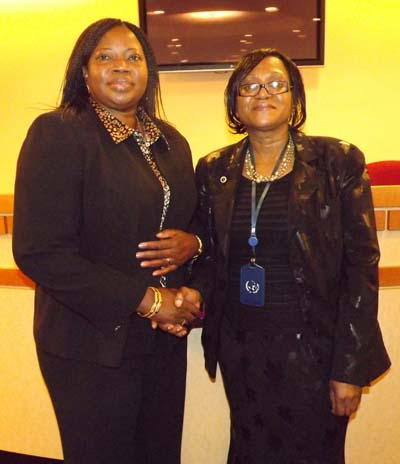
Fatou Bensouda, Prosecuter Elect, International
Criminal Court,
MS. Ugoji Adanma Eze, Esq. President and CEO, Eng Aja Eze
Foundation. |
|
 |
|
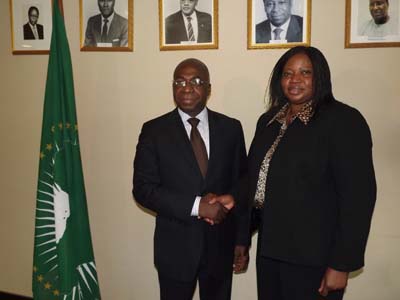
Tete Antonio, Ambassador Permanent Observer, African
Union,
Permanent Observer Mission to the United Nations,
Fatou Bensouda, Prosecuter Elect, International Criminal
Court,
|
|
Ms. Fatou Bensouda
Prosecutor‐elect of the International Criminal Court
The incidence of the Female Child Soldier and the
International
Criminal Court
Eng Aja Eze Foundation
Keynote speech
4 June 2012
New York
Excellencies, Ladies and Gentlemen,
Allow me to start by thanking the Eng Aja Eze Foundation for
inviting me to address you today, on the occasion of the
International Day of the African Child, on the critical
issue of girl child soldiers, and the role of the
International Criminal Court.
As the Special Representative for Children and Armed
Conflict of the UN Secretary General Radhika Coomaraswamy
indicated while testifying as an expert witness in Lubanga
case at the ICC: “girls play multiple roles in conflict,
including combat, pottering, scouting but also sexual
slavery […]
We need to draw attention to the roles girls play and the
need to protect them in every context.”
Indeed, one of the most fundamental aspects of the crime of
utilizing child soldiers in armed conflicts is its gender
aspect. According to estimations, there are 250.000
childsoldiers in the world today; 40% of these children.
The main functions of these girls are to act as soldiers but
also as “wives” of male
soldiers, a mere euphemism for sex slaves. Girls are,
indeed, more susceptible to being abused as child soldiers
due to the multiplicity of their assigned roles, and
especially when they are used as sex slaves.
This vulnerability, deeply linked with social gender
representations, is particularly
reflected in the stigmatization girls soldiers may face
during
the reintegration process.
Indeed, sexually exploited girls are often seen as being
“immoral” or “unclean” by the members of their community.
As UNICEF noted in their submissions on reparations to the
Judges in the Lubanga case, many girls who have been through
these atrocities try to keep their pasts hidden to avoid
stigmatization in their communities. This prevents victims
from being taken into account to see their suffering
addressed in an attempt to heal. It also creates
significant outreach problems for ending the impunity of
perpetrators.
The situation in Sierra Leone provides an illuminating
example of why we need to
focus more carefully on girl soldiers. The Disarmament,
Demobilization and
Reintegration (DDR) programs in Sierra Leone, carried out in
the aftermath of the armed conflict, were not designed with
a specific focus on girl soldiers. The programs often
required the child soldiers to hand in a weapon, a process
which excluded those who did not carry a gun. According to
UNICEF, at the end of the disarmament and demobilization in
Sierra Leone, 6,845 children were demobilized, of which 547
were girls, but a good number of the girls were left behind
and did not go through the DDR program itself.
As many observers have indicated, this lack of focus results
in lack of female
participation in official reintegration programs, and as a
consequence, many girls who leave the armed forces end up
with little support, no financial means and forced into
situations where they are trading sex for food, shelter or
money, simply to survive.
I would like to talk to you today about what the recent
international developments made to address this issue, and
how the Office of the Prosecutor of the ICC has been working
to ensure that never again, the plight of these girls is
forgotten or trivialized;
that they are not invisible from the scope of the law and
the
reintegration programs.
1) INTERNATIONAL DEVELOPMENTS REGARDING GENDER CRIMES AND
THE ROME STATUTE
The recognition of “gender violence” or “gender crimes” as
such is relatively recent development in international law.
Remember that Robert Jackson, the Chief Prosecutor of the
Nuremberg Tribunal, decided not to present sexual crimes in
the case against Nazi Leaders.
It was only in the early 1990s that there was a greater
emphasis on gender crimes. This impetus was furthered with
the efforts of obtaining accountability in the mid‐90s for
atrocities committed against women during the conflict in
the former Yugoslavia, which paved the way of the
establishment of how rape and other forms of sexual violence
could be instrumentalised in a campaign of genocide. This
equally contributed to the expansion of the understanding of
sexual or gender violence as war crimes and crimes against
humanity.
But perhaps the most groundbreaking decision advancing
gender jurisprudence
worldwide was the Akayesu judgment delivered by the Trial
Chamber of the
International Criminal Tribunal for Rwanda on 2 September
1998. For the first time in history, rape was explicitly
recognized as an instrument of genocide. As described by the
ICTR in the Akayesu case, rape is used to
“kill the will, the spirit, and life itself”.
The decision by the ICTR Chamber provided a definition of
rape as well, – “a physical invasion of a sexual nature
under circumstances which are coercive” – placing gender
crimes in a larger context. The evolution of the
international criminal law regarding gender crimes has
continued in the recent years. The Special Court for Sierra
Leone’s RUF trial judgement in 2009 constitutes a landmark,
as for the first time in history, an
international or internationalized tribunal has brought
convictions regarding crimes against humanity of sexual
slavery and forced marriage as an
inhumane act.
The Rome Statute of the International Criminal Court is a
result of these recent
developments in international law and progress in the human
rights field, which the international community as a
whole, composed of representatives of
governments, NGOs, international institutions, have
recognised gender violence and gender crimes as crimes of
international concern.
Gender related violence or “gender crimes” is a firmly
established concept in the Rome Statute. Under Article
7(1)(h), persecution against any identifiable group or
collectivity on grounds of gender could constitute a crime
against humanity if committed in connection with other types
of crimes against humanity or other crimes under the
jurisdiction of the Court. Various provisions of the Statute
prescribe what can be characterized as gender crimes. Rape,
sexual slavery, enforced prostitution, forced pregnancy and
enslavement, including trafficking, are some of these
characterizations
which can be categorized as war crimes and/or crimes against
humanity.
Therefore, and although the forms of brutality and violence
committed against girls and women during armed conflicts are
in many respects unspeakable, we now have the strength of
the law, the Rome Statute, to give voice and language to
these crimes.
2) OTP STRATEGIES, POLICIES AND CASES
The Office of the Prosecutor, within its mandate prescribed
by the Statute, is engaged on gender related issues in
multiple ways. Article 54(1)(b) of the Statute specifically
provides that the Prosecutor shall “take into account the
nature of the crime in particular where it involves sexual
violence, gender violence, or violence against children”.
Sensitivity towards gender issues is all the more prescribed
in relation to the protection of witnesses and victims.
According to Article 68(1) of the Statute, “the Court…shall
have regard to all relevant factors, including gender and
the nature of the crime, in particular, where
the crime involves sexual or gender violence or violence
against children.”
Additionally, Article 42(9) of the Statute requires the
Prosecutor to appoint advisers with legal expertise on
specific sexual and gender violence. I am proud to have been
the Office’s focal point for gender related issues since the
start of my mandate as Deputy Prosecutor. The Office also
established a unit, the Gender and Children Unit, comprised
of advisers with legal and psycho‐social expertise to deal
specifically with gender and children issues. The GCU
advises the Prosecutor directly and provides support to the
Office’s divisions, from pre‐analysis through to prosecution
phases.
The OTP has also consistently endeavoured to ensure that its
staff receives the proper training to integrate a “gendered”
perspective into its investigations and prosecution, whilst
at the same time presenting gendered aspects of conflict in
connection with the contextual elements of the crimes as
defined by the Rome Statute. Our investigators and lawyers
receive specialised training on the legal framework and
methods forconducting gender crime related interviews.
The OTP’s sensitivity toward gender aspect of crimes is well
reflected in its
investigation into cases regarding child soldiers. The OTP
has brought charges of
enlistment, conscription and the use of children to
participate actively in hostilities
against seven individuals and across four cases. The first
trial before the Court against Thomas Lubanga Dyilo, was a
landmark in the international criminal law history. With the
verdict, enlistment and conscription of children under the
age of 15, for the first time, was internationally
criminalized. The case also had a very strong gender aspect,
a subject I will further analyze in the latter
parts of my speech.
Similar sensitivities were also taken into consideration in
the Kony and
Katanga/Ngudjolo cases. Our investigation into the situation
in Uganda showed not only how the Lord’s Resistance Army
systematically abducted girls for sexual
enslavement and rape, but also how the LRA leader, Joseph
Kony, controlled all
aspects of how girls are abducted, distributed to LRA
commanders, and enslaved. He allocated abducted girls as a
reward to the commanders, to be used as sex slaves. Kony
himself has had as many as fifty abducted girls in his
household at one time‐‐girls who were enslaved and raped.
The LRA attempted to mask their criminal acts by calling the
enslaved girls “wives” or “sisters.” Today, such crimes are
still continuing in Uganda.
Amid the civilians that were abducted from CAR, Sudan, and
the DRC pursuant to orders by Joseph Kony to abduct one
thousand new “recruits,” many women continue to be used as
sexual and domestic slaves.
With respect to the case against Germain Katanga and Mathieu
Ngudjolo Chui, theProsecution also presented charges related
to gender crimes, namely, sexual slavery and rape, both as
crimes against humanity and war crimes as well as using
child soldiers as a war crime. Both men are charged with
ordering the attack upon the village of Bogoro, in Ituri, on
24 February 2003. Hundreds of civilians were massacred
during the attack, civilian’s residences were looted and
destroyed, and women and girls were raped. According to the
evidence collected, some women, who were captured at Bogoro
and spared by hiding their ethnicity, were taken to FNI and
FRPI camps, after being undressed or raped upon their
capture. Once there, they were given as ʺwifesʺ to their
captors or kept in the campʹs prison. The women detained in
these
prisons were repeatedly raped by soldiers and commanders
alike.
The use of child soldiers was also included in the arrest
warrant for Bosco Ntaganda, and as you may be aware, we
recently applied for a new arrest warrant to include charges
of rape, sexual slavery, murder, persecution, intentional
attack against civilians and pillaging.
Our Office has taken very seriously the crimes committed
against children in the
context of armed conflict and in so doing we believe we are
contributing to not only accountability for these crimes but
also to the larger recognition of the legal rights of
children, including the right to a childhood free from
violence, coercion and fear.
Additionally, these cases involve gender related crimes of
sexual slavery and rape, and crimes of enlisting and
conscripting child soldiers. These experiences clearly
illustrate that these two heinous crimes go hand in hand,
especially when they involve female children.
3) OTP INTERACTION WITH FEMALE CHILD SOLDIERS
During the investigation which resulted in the arrest and
trial of Thomas Lubanga Dyilo, the Office of the Prosecutor
interacted with five female former child soldiers. At the
time of interview, some of them were very fragile and
emotional, whereas one was rather adamant not to be
considered as a victim. All of them had physical health
complaints – chronic and acute pains, urinary infections and
experienced trouble sleeping. Out of five of them, two
suffered from severe avoidance symptoms.
The Office of the Prosecutor is cognizant of the fact that
the victims and witnesses it interacts with, especially
those of sexual violence crimes and children, will in most
cases be very fragile. During preparation for deployment to
the field to conduct interviews of female child soldiers,
the Office addresses issues in order to guarantee
maintaining their dignity, physical and psychological
well‐being.
It is the practice of the Office to obtain the consent of
parents or care‐givers of children and that practice was
respected before any interaction with the female child
soldiers interviewed. Bearing in mind that they were
children and because of the unfortunate experiences, the
Office offered them support right from the initial stage of
our interaction; they were entitled to attend interviews
with an accompanying person of their choice.
To ensure that each child was in a fit condition to go
through the interview process without re‐traumatization, all
five of them went through a psycho‐social pre‐interview
assessment conducted by a psycho‐social expert. At the
conclusion of the assessment, the expert made a
determination of the child’s suitability to be interviewed.
This determination was final and was respected by
investigators. If approval is given for the interview to
proceed, the expert either sits in the interview to provide
support to investigators and/or the children or makes crises
interventions if and when necessary.
During our interaction, certain fundamental principles,
including respecting the
principle of confidentiality and non‐exposure of the
children, had to be thoroughly respected. As well as boys,
girl child soldiers may have committed crimes during
theperiod they were with the fighting forces, and the
feeling of guilt causes reluctance in them to give a
narration of their experiences. In our interaction, it is
important to explain Article 26 of the Rome Statute and give
them the assurance that they will not be prosecuted.
The Victims and Witnesses Unit in consultation with the
Office of the Prosecutor, has developed both an Initial
Response System and Secondary Response System which
witnesses can trigger in case they feel threatened and are
in
|need of protection.
In addition, the Court provides various forms of assistance
to witnesses and a referral procedure has been set up
between the VWU and the OTP whereby witnesses in need of
assistance ‐ especially medical and psychological
interventions ‐ are referred to VWU for provision of the
assistance.
It is our strong belief that justice cannot be done in or
out of the courtroom if the voices of female child soldiers
are not heard.
Inside the courtroom, it is important for the gender
component of conscription and enlisting to be mentioned in
order to highlight the different dimensions of those crimes
and their consequences, thereby participating in the
determination of the whole truth.
We also have to focus on the planning, designing and
implementing of prevention, demobilization and reintegration
programs so that the unique needs of girls are taking into
consideration from the inception. Their voices must be heard
so that the international community understands their story
and their plight as they look for ways to make a
contribution, do something meaningful and productive with
their life, and try to make up for the harm inflicted on
them through any possible means of reparations.
4) THE LUBANGA CASE AS A LANDMARK
As previously stated, the Lubanga verdict was a landmark
decision in relation to
gender crimes and child soldiers. During our opening
statement in January 2009, we presented the gender
dimensions of the crime of enlisting and conscripting
children under the age of fifteen years. The evidence showed
how Lubanga instrumentalised sexual violations to subject
child soldiers of both sexes to his will, and made them
tools to further his own violent goals.
In the camps, child soldiers were exposed to sexual violence
perpetrated by Lubanga’s men. In the training camps, girl
soldiers were the daily victims of rape by thecommanders.
Girl soldiers, some aged twelve years old, were used as
cooks and fighters, cleaners and spies, scouts, and sexual
slaves.
One minute they would carry a gun; the next minute, they
would serve meals to the commanders; the next minute, the
commanders would rape them.
They were killed if they refused. One child soldier became
severely traumatised afterkilling a girl who refused to have
sex with a commander. Our evidence showed that assoon as the
girls’ breasts started to grow, Lubanga’s commanders could
select them astheir forced “wives” and transform them into
their sexual slaves. One of our witnesses described how he
observed daily examples of his commanders raping girl
soldiers.
Their right to a childhood, to safety and protection, to
physical integrity, education, toexercising their
reproductive rights and health and sexual autonomy, were
denied and destroyed.
Although the Prosecution did not include specific charges
related to sexual violence in the Lubanga case, it did make
it a priority to lead and elicit evidence of sexual abuse
and violence suffered by the female child soldiers within
the UPC/FPLC military.
The Prosecution called a female child soldier who gave a
graphic account of the
prevalence of the gender based violence that existed in the
UPC and recounted how she was also the subject of gender
based harm.
As we demonstrated during the trial, rape and other forms of
sexual violence were
integral to the enlistment and conscription of girls by the
UPC, and an ongoing
component of the ways in which girls and young women were
used to participate
actively in hostilities.
Although gender crimes were not distinctly present in the
final verdict rendered by the Judges, Judge Odio‐Benito
provided a separate opinion, agreeing with the Prosecution
that gender crimes were embedded in the recruiting of
children and in their use in hostilities: “It becomes
irrelevant, therefore, if the prosecution submitted the
charges as separate crimes or rightfully included them as
embedded in the crimes of which Mr Lubanga is
accused. The harm suffered by victims is not only reserved
for reparations proceedings but should be a fundamental
aspect of the Chamber’s evaluation of the crimes committed”.
Judge Odio‐Benito found that the invisibility of sexual
violence in the legal concept leads to discrimination
against the
victims of recruitment.
It is our responsibility to present the gender crimes
suffered
by the most vulnerable.
During the course of the trial, the Office has made it its
mission to ensure that Thomas Lubanga Dyilo be held
criminally responsible for the atrocities committed against
those little girl soldiers, when he enlisted and conscripted
them to be used as sexual prey, while also using them in
combat.
In the International Criminal Court, children, including
girls, will not be invisible. It is our hope that the
Lubanga ruling could change the life of these girls; never
again should they be left out of the assistance provided by
demobilization programmes. In this sense, the harm they
suffered from has been remarkably mirrored in the
submissions on reparations commanded by the Judges and
introduced by various
participants in the case, including the OPCV, ICTJ, UNICEF
and Women’s Initiatives for Gender Justice.
5) CONCLUSION
In order to understand the effectiveness of the Court, one
has to asses the impact it has over the world. Even
before the verdict, the Lubanga trial has helped trigger
debates on child recruitment in countries like Colombia or
Sri Lanka, and child soldiers have been released in Nepal.
The Special Representative of the UN Secretary‐General,
Rhadika Coomaraswamy factored in such potential and used it
as a tool to campaign around the world, and secure
additional releases. This is an example of how to use the
law to prevent crimes and change the lives of millions. The
impact of the Lubanga case,
as well as other cases before the Court, however, depends on
the subsequent actions of a wide range of actors.
One last, but definitely not the least, point I want to make
is about the effects of armed conflicts and international
crimes over the education of children.
Sheikha Mozah of Qatar, UNESCO Special Envoy for Basic and
Higher Education, clearly stated that the world cannot
continue to ignore the impact that armed conflict and
international crimes have on education. Staff at Qatar‐based
Education Above All, an organisation which she chairs,
analysed the information collected by the Prosecutor in the
Lubanga case.
Their findings show how Thomas Lubanga Dyilo’s crimes
interrupted, delayed and denied the right to education to
Ituri children. In addition to the children abducted to
become child soldiers, other children stopped going to
school for fear of being abducted. Because of Mr. Lubanga
Dyilo, these children lost
out on their education.
And Ituri is just one example of the devastating effect that
international crimes have on education: according to the
Education for All Report published by UNESCO in 2011, 28
million children of primary school age in conflict‐affected
poor countries are out of school. These children need to be
included in the education system as education is the
most effective way of reintegrating them back into their
communities.
We have to reach out and help these children, the ones who
are affected the most bythe vicious nature of armed
conflicts.
As I have repeatedly said, the crimes committed towards
female child soldiers need to be analyzed specifically. Our
focus should shift from “children with arms” to “children
who are affected by the arms” in the context of crime of
enlisting and conscripting child soldiers. I, as the new
Prosecutor of the ICC, will make sure that such crimes and
victims will no longer be ignored and perpetrators will face
justice.
Thank you. |
Eng
Aja Eze Foundation
THE
INCIDENCE OF THE FEMALE CHILD SOLDIER AND
THE INTERNATIONAL CRIMINAL COURT
FEMALE CHILD SOLDIERS
Throughout history children have been
gravely affected by armed conflict. They are
victims of genocide, crimes against
humanity, and war crimes. The international
community ignored the plight of children
until quite recently. Crimes against
children had gone largely unpunished and
perpetrators of such crimes had not been
held accountable.
In recent decades, the international
community has begun to recognize the
horrendous crimes committed against children
in armed conflict.
Unfortunately, A much greater deal of
attention is paid to male child soldiers and
one rarely speaks or highlights the plight
of female child soldiers.
Few female child soldiers have appeared at
the ICC. One reason is the time lapse
between the end of the conflict and the
commencement of the trial, by which time the
girl has become a woman. In addition, few
trials until very recently have involved
violations against children. This is because
international prosecutors are very reluctant
to rely upon the evidence of children whom
they consider to be less reliable witnesses
than adults, and even more so if there is a
long delay between the alleged crime and the
actual trial.
WHAT WE DO
The Eng Aja Eze Foundation advocates for
children who have suffered violations of
their fundamental human rights and ensure
that they can have access to justice and
make their voices heard.
We tell children that they can have their
voices heard in judicial and non-judicial
forums. We work with them to manage their
expectations and to assist them by giving
evidence at the ICC and in national courts.
THE INTERNATIONAL CRIMINAL COURT
The ICC offers an alternative and innovative
mechanism by which children who are victims
of International Crimes can access justice.
Instead of giving evidence as a witness in
open court, the ICC permits the child to
seek Victim Status instead.
There is a witness protection program in
place that deals with the procedures for
testimony given by “vulnerable witnesses.”
The main objective of this program is to
protect the psychological well being,
dignity and privacy of witnesses, especially
those who are at risk of psychological harm
through the process of giving testimony.
The advantages for the child are :
- They are entitled to Legal
Representatives.
- The children are not required to attend
the proceedings;
- Victim Status allows for a larger number
of children who have suffered harm to access
justice and;
- The Victim and Witness Unit of the ICC
provides support and protective measures to
children granted victim status. Some of
these protections include the holding of
hearings in camera, the victim’s freedom to
withhold their name, place of residence and
any distinguishing features from the public
and the press.
How effective is the International Criminal
Court in protecting the victims?
Some issues for consideration include:
- Once the victim is in The Hague, to what
extent is she protected? Is there is a
chance she may see her perpetrator? If she
does see her perpetrator she may become
terrified and choose to withhold her
testimony or refuse to speak.
- Once the trial has concluded, how is the
victim further protected?
- Are female child soldiers sent back to
their communities?
- In some cases a female victim is again
stigmatized in her community when she
chooses to testify in a trial in The Hague.
She may feel pressured to remain away from
her village. In such instances, and many
others, can she pursue asylum in The Hague?
Female child soldiers also face fear of
reprisals. When the perpetrators and victims
live in the same community, they often
suffer re-dramatization as a result of
having to relive the events and undergo
cross examination.
Another issue that recently arose should be
addressed. In March of this year, during the
trial of Thomas Lubanga Dyilo, the ICC noted
that while witnesses testified to female
sexual violence and rape, these crimes were
not part of the charges against the accused.
The Judges have left unresolved whether
facts relating to sexual violence against
girls should be taken into account for the
purposes of sentencing and reparation. What
does this mean for female victims in future
trials?
TRUTH AND RECONCILIATION: A VALUABLE
ALTERNATIVE?
Unfortunately, currently only a small
portion of children who have suffered harm
in armed conflict will actually come before
the International Criminal Court in The
Hague.
While the popular view is that non-judicial
mechanisms can provide more accountability,
enable community involvement, and provide
reparations for the losses and damages that
occurred, this is not often the case.
Once female child soldiers return home, they
often encounter a great deal of prejudice
within their communities because not only
did they take up arms, but the sexual human
rights violations perpetrated against them
carry
a negative stigma.
Truth and Reconciliation Commissions are
often flawed as they fail to address many
needs of the child victims. This begs the
question; do traditional judicial forums
like the International Criminal Court
provide greater relief to the victims?
REPARATIONS
The concept of reparations acknowledges the
harm that victims have suffered and aims to
return victims to their previous condition
to the maximum extent possible.
Once a girl soldier’s childhood is stolen,
it cannot again be retained solely through
financial reparations.
Alternative reparation programs, including
the establishment of a national holiday for
the commemoration of the victims and the
funding of rehabilitation centers, must be
pursued.
Ugoji Adanma Eze Esq All rights Reserved
@2012
http://engajaezefoundation.org
|
|
American Society of International Law |
Our Mission
The mission of the American Society of
International Law is to foster the study of
international law and to promote the
establishment and maintenance of
international relations on the basis of law
and justice.
Our Organization
ASIL is a nonprofit, nonpartisan,
educational membership organization founded
in 1906 and chartered by Congress in 1950.
ASIL holds Category II Consultative Status
to the Economic and Social Council of the
United Nations and is a constituent society
of the American Council of Learned
Societies. The Society is headquartered at
Tillar House in Washington, D.C.
• Member Brochure (Adobe Acrobat
required)
• Membership Application (Adobe Acrobat
required)
Our Members
The Society's 4,000 members from nearly 100
nations include attorneys, academics,
corporate counsel, judges, representatives
of governments and nongovernmental
organizations, international civil servants,
students and others interested in
international law.
Our Programs
Through our meetings, publications,
information services and outreach programs,
ASIL advances international law scholarship
and education for international law
professionals as well as for broader
policy-making audiences and the public.
Our History
ASIL was established in 1906. While our
educational mission remains as central today
as it was then, our programs have adapted to
dramatic changes in international law, as
both an expansive topic and an evolving
professional discipline. The Society
celebrated its Centennial in 2006 under the
theme, "A Just World Under Law."
Constitution and Regulations
Click
here for ASIL's Constitution/Regulations
in pdf.
Our Bi-Annual Report
The Society's 2008-2009 Bi-Annual Report
"Engaging the International Law Community"
is available
here in PDF.
http://www.asil.org
|
|
The Trust Fund for Victims |
|
The Trust Fund for
Victims is the first of its kind in the global movement to
end impunity and promote justice. At the end of one of the
bloodiest centuries in human history, the international
community made a commitment to end impunity, help prevent
the gravest crimes known to humanity and bring justice to
victims with the adoption of the Rome Statute. This treaty -
voted for by 120 nations in 1998 - created the International
Criminal Court to prosecute those responsible for genocide,
crimes against humanity and war crimes. For the people who
suffer most from these crimes, and who too often are
forgotten, it set forth the mandates of the Trust Fund for
Victims. In 2002, the Rome Statute came into force and the
Assembly of States Parties established the TFV.
You can read more
about our past and
current projects in
our Programme
Progress Reports:
-
Summer 2011 (ENG /
FRA)
-
Fall 2010 (ENG
/
FRA)
-
Spring 2010 (ENG)
-
Fall 2009 (ENG)
The Trust Fund for
Victims supports
activities which
address the harm
resulting from
crimes under the
jurisdiction of the
International
Criminal Court by
assisting victims to
return to a
dignified and
contributory life
within their
communities. The TFV
develops its
activities with the
victims themselves
as partners, helping
them rebuild their
families and
communities and
regain their place
as fully
contributing members
of their societies.
Our Fall 2010
Programme Progress
Report is available
in English and French (PDF).
This report -- Learning
from the TFV's
Second Mandate: From
Implementing
Rehabilitation
Assistance to
Reparations --
provides a detailed
update on the TFV's
active projects in
the situations of
northern Uganda and
the Democratic
Republic of the
Congo. The report
builds on the TFV's
field experience and
results from our
survey of 2,600
victims receiving
assistance in both
situations to
reflect on lessons
learned for
Court-ordered
reparations. Also
available are our Spring
2010 Programme
Progress Report on Recognizing
Victims and Building
Capacity in
Transitional
Societies and
our Fall
2009 Programme
Progress Report.
Currently, the TFV
is providing a broad
range of support
under its second
mandate - including
vocational training,
counselling,
reconciliation
workshops,
reconstructive
surgery and more -
to an estimated
70,000 victims of
crimes under the
ICC's jurisdiction.
We are also in the
process of accepting
expressions of
interest for
projects supporting
victims of sexual
violence in the
Central African
Republic. The
submission window is
now closed. But more
info on the TFV's
CAR programme can be
found here:
-
Description du
programme / Programme
Description
-
Formulaire de
demande / Application
Form
-
Questions posées
-
Communiqué de presse / Press
Release
The TFV employs two
targeting strategies
for this assistance:
(1) projects
tailored to meet the
needs of victims of
specific crimes and
(2) large-scale
projects to help
communities rebuild
themselves and
establish long-term
peace and
reconciliation. You
can read more about
these on our projects and success
stories pages.
You
can also find more
information about
our legal basis, our
two mandates, and
our current projects
using the links
above. For more
information, or to
make a donation,
please contact us
at Trust.Fund@icc-cpi.int.
|
|
http://www.trustfundforvictims.org/ |
|
|
|
| |
|
|
Back To
Society News |
|
| |
|
|
|
|