Black Tie
International Magazine China 1
2 3
4
www.blacktiechina.com
|
|
Share this page with your friends |
|
|
|
www.blacktiemagazine.com
Jeff Ye
Collection:
Jeff
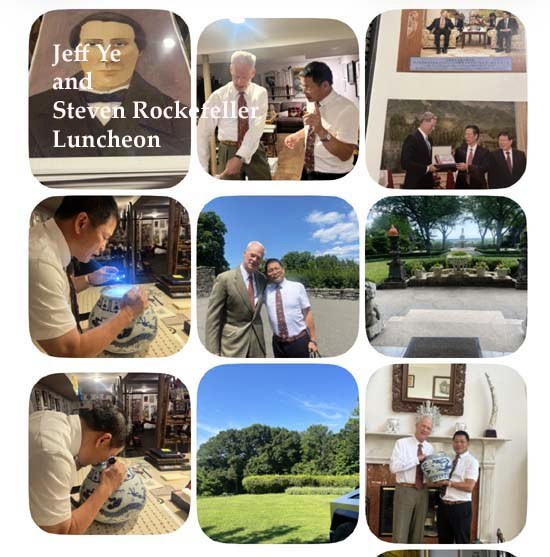
Ye and Steven Rockefeller Luncheon |
|
|
 |
|
|
Jeff Ye and Steven
Rockefeller Luncheon
A Beautiful Lunch, A Great Beginning
Epilogue: They Collected Each Other
By Dr. Jeannie Yi, New York |
|
|
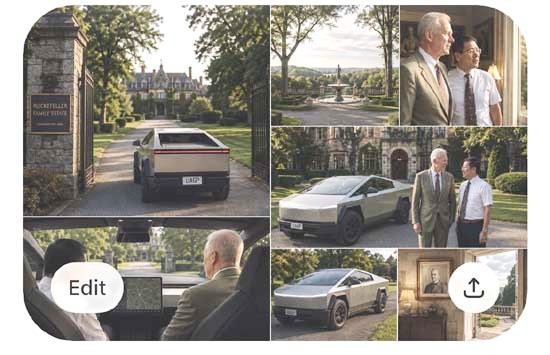 |
As the late afternoon sun poured liquid gold across the
endless woods surrounding the estate, we slowly drove down
the long,
tree-lined driveway.
Our fully equipped Cybertruck glided forward like a
modern-day tank from Toy Story—quietly expressing the logic
of autonomous driving: Why should something as dangerous as
driving still be left entirely to human beings?
Inside the vehicle, we were unusually quiet.
Only then, after five and a half hours around the lunch
table,
did the fatigue begin to settle in.
That afternoon, I witnessed something extraordinary.
I watched two great collectors accomplish something far more
remarkable than acquiring another masterpiece.
They collected each other.
Jeff collected Steven.
Steven collected Jeff.
What they collected was not each other’s works of art.
Nor each other’s wealth.
Nor even each other’s network of relationships.
What they recognized—and chose to treasure—was something
much rarer.
A remarkable character.
An eye refined over decades.
A reputation built over a lifetime.
A commitment to long-term thinking that only time can
create.
In Jeff, Steven saw a genuine Chinese collector.
Not because he possessed an extraordinary collection of
ancient Chinese masterpieces.
But because behind every single object lay decades of study,
comparison, authentication, collecting, and unwavering
commitment.
He saw carefully preserved ancient Chinese artworks that had
undergone modern scientific testing and dating.
He saw physical evidence spanning more than two thousand
years
of history.
Most importantly, he saw the accumulated knowledge,
research, judgment, and responsibility embodied in every
object.
He was not simply looking at a collection.
He was looking at an entire body of knowledge—one built over
nearly thirty years, continuously tested, refined, and
strengthened.
Likewise, what Jeff saw in Steven was far more than the
Rockefeller name.
He saw a family that had spent more than a century
putting one belief into practice.
Wealth is not only something to be created.
It is something to be passed on.
Responsibility does not belong only to the present.
It belongs equally to the future.
At that moment, I also began to understand the true meaning
of
artificial intelligence.
AI will never replace Jeff’s thirty years of deep
scholarship
devoted to ancient Chinese art.
Nor will AI replace the century of experience, values, and
institutional wisdom passed down through the Rockefeller
family.
What AI can do is something different.
For the first time, it allows knowledge and experience that
once existed only among a small circle of people to be
shared at unprecedented speed
and scale.
Jeff continues to research.
Steven continues to document.
I continue to tell the story.
AI continues to learn.
And with that, a new cycle begins.
Not the compounding of capital.
Not the compounding of interest.
But the compounding of knowledge.
The compounding of trust.
And ultimately, the compounding of collaboration.
Every new discovery enriches the entire body of knowledge.
Every new story helps more people appreciate the
significance
of ancient Chinese art.
Every meaningful exchange builds new trust between East and
West.
And every lesson absorbed by AI preserves, organizes, and
amplifies these experiences, inspiring yet another
generation of creativity.
That is when I finally understood what UAJP has truly been
collecting
all along.
It has never been merely a collection of ancient Chinese
masterpieces.
It has been collecting trust—trust that has been tested and
strengthened over time.
It has been collecting shared values—the universal pursuit
of truth, beauty, and responsibility across different
civilizations.
It has been collecting the courage to believe in the future.
Many years from now, when people look back on the founding
of UAJP, they may not remember the details of the business
models discussed
that day.
But they will remember that at an estate just forty-five
minutes from Manhattan, a five-and-a-half-hour lunch brought
together two collectors who chose to collect each other.
And together, they embraced a dream far greater than
themselves:
To help ancient Chinese art reach the world through the
power of AI;
And to help the world better understand China through the
enduring beauty of its ancient artistic heritage.
For the greatest partnerships are never built merely on
opportunity.
They are born when each person recognizes, in the other,
a better version of themselves. |
|
|
|
Additional Coverage
of the Jeff Ye Collection |
|
|
|
www.blacktiemagazine.com
Refined by Fire: The Inner Journey of Jeff Ye |
|
|
 |
|
Jeff
Ye, Master Collector of Chinese
Antiquities |
|
|
|
Refined
by Fire:
The Inner Journey of Jeff Ye,
Master Collector of Chinese Antiquities
My life has been like a piece of
glazed glass,
sent again and again into the fire.
Jeff Ye
Report by: Dr. Jeannie Yi
|
|
|
|
|
|
|
Click Here to view the video if your
browser is not displaying
the English and Chinese captions |
|
|
At the beginning of 2026, a moment of
particular significance quietly took
place in New York, a city where art and
finance converge.
After years of anticipation
The International Institute of Art
Asset (IIAA)
was formally established.
Its importance reaches far beyond the
founding of another institution. For the
first time, a clear structural pathway
emerged for Eastern art to enter the
Western world—not merely as cultural
display, but as a system grounded in
valuation, legitimacy, and sustainable
commercial return. What had long existed
as aspiration was now becoming reality.
Throughout human history, the forms of
wealth have continuously transformed:
from gold and silver, to land, to
financial instruments, to luxury goods.
Yet among all these, only collecting
truly connects us to the roots of
civilization itself.
Collecting is often misunderstood as a
gesture of wealth or status. In truth,
it is an act of remembrance. Through
porcelain, jade, and bronze, we glimpse
the lives, values, and spirits of our
ancestors. Each artifact is not merely
an object, but a living fragment of
time.
Sitting across from me during this
interview was Jeff Ye, one of the
five co-founders of the International
Institute of Art Asset and the director
responsible for its antique and museum
collections.
In his hands, he held a remarkable
imperial
“Dragon Plate,”
inscribed with the phrase
“Mandated by Heaven.”
The object was overwhelming in its
presence.
This was not possession in the ordinary
sense. It was guardianship.
Jeff Ye owns thousands of such
treasures. His collecting journey has
taken him across China, from academic
research to remote regions, from
established markets to newly discovered
sites. Whenever news surfaced of an
unearthed artifact, he would go—without
hesitation.
What he collects is not defined by
money, but by responsibility.
Responsibility to history.
Responsibility to civilization.
This is where collecting transcends
wealth
and becomes a form of cultural
stewardship.
|
The glazed glass of the Spring and
Autumn and Warring States periods is
breathtaking in both color and form.
Perfectly round, crowned with a dragon,
it carries a blessing: auspiciousness,
peace, and harmony.
It is, in essence, China’s gift to the
world.
And it is also the spiritual origin of
the Art Asset Institute—
the mission of the descendants of the
dragon:
to protect, transmit, and honor
civilization.
For Jeff Ye, collecting has never
been defined by money.
It is defined by whether one is willing
to bear responsibility for civilization
itself.
When the Rockefeller family and the
Rockefeller Foundation traveled
repeatedly to China, they were certainly
not seeking oil deals or architectural
investments. They were searching for
treasures like those now resting on Jeff
Ye’s table—fragments of history that
allow future generations to see, with
their own eyes,
stories that began thousands of years
ago.
If collecting carries a certain
aristocratic spirit,
then this spirit takes many forms.
In Jeff Ye’s “aesthetic style of
collecting,”
I saw not luxury, but guardianship.
A guardian who has spent more than
thirty years
preserving cultural memory.
While managing real estate development
projects, he carved out rare time to
enter China’s once chaotic antique
markets, patiently watching them evolve
into systems of order. Again and again,
he searched—sometimes close to home,
sometimes across great distances
—for artifacts that carried the breath
of history.
At first, like many collectors, his
questions were simple:
“Is it beautiful?”
“Is it valuable?”
But gradually, his questions became
deeper:
Where did it come from?
Does it align with historical logic?
Can it withstand scientific scrutiny?
He once asked me quietly,
“Can its materials, craftsmanship,
patina, oxidation, perforations, and
color transformation endure both
scientific testing
and experiential judgment?”
I had no answer.
Though my own family had passed down
certain “treasures” through generations,
they lay untouched in cabinets
—unpriced, unrecognized, untradeable.
Jeff Ye, trained in chemistry,
understood that intuition alone was not
enough.
For collectors and enthusiasts alike, he
developed a rigorous system:
a twenty-criteria methodology for jade
authentication that moves from instinct
to science—
now known as the “Ye Standard.”
He said:
“Forgery in antiques is actually a false
concept.
Only time leaves irreversible marks.
To claim something can be perfectly
forged
is to claim time itself can be reversed.
Anyone with basic logic knows this is
impossible.”
In Jeff Ye’s system, the first judgment
is never data—it is breath.
Not reports, but whether the object
possesses a soul.
He believes in eye connection.
He believes in touch.
He believes in the intelligence stored
within the body
through years of experience.
For him, collecting is not ownership—it
is encounter.
A meeting between human and artifact,
guided by fate.
Much like love itself: different in
form, universal in essence.
That love pushed him to unite
aesthetics, history, chemistry,
microscopic observation, and instrument
testing.
To synchronize intuition with science.
In his world, collecting becomes a true
“cultural science”—
and an inheritance of love.
Not merely feeling,
but a civilization authentication
system.
From instinct and romance,
to verification and responsibility.
Like glazed glass itself,
his life has been shaped by fire—
again and again refined,
until clarity became light. |
|
|
 |
 |
 |
|
|
 |
|
|
 |
|
|
 |
 |
 |
 |
 |
 |
|
Additional Black Tie Featured Articles -
Jeff Ye |
|
|
|
www.blacktiemagazine.com
Jeff Ye - From New York to the Desert of Gold |
 |
Jeff Ye,
Master Collector of Chinese Antiquities
From New York to the Desert of
Gold
A Journey Where Vision Found Its Geography
By Dr. Jeannie Yi |
|
|
|
www.blacktiemagazine.com
Jeff Ye, World
Speakers Series, Trump Tower, NYC |
 |
|
Elvis Newman, Jeff Ye, World
Speakers Series, Trump Tower, NYC |
Jeff Ye, World
Speakers Series, Trump Tower, NYC
Love Letter to Life: Yongzheng and His Porcelain
When Civilization Blossomed Like a Flower
Report by: Dr. Jeannie Yi |
|
|
|
www.blacktiemagazine.com
Jeff Ye:
The Man Who Put Time on the Table |
 |
Gerard Mc Keon,
Publisher, Black Tie International Magazine
Jeff Ye, Master Collector of Chinese Antiquities |
| |
|
|
| |
|
|
Back To Society News |
|
| |
|