Black Tie
International Magazine China 1
2 3
4
www.blacktiechina.com
|
|
Share this page with your friends |
|
|
|
Jeff Ye - the Golden Age of the Tang Dynasty |
|
www.blacktiemagazine.com |
| |
 |
| |
Seeing the Golden
Age of the Tang Dynasty
Through Gilt Silver Treasures
Wall Street Podcast Distinguished Lecture Series,
100 Hall of Fame Lecture One
By Dr. Jeannie Yi
One afternoon, I visited the offices of Universal Ancient
Jade Pavilion (UAJP) on the eighth floor of Rockefeller
Center in New York. What I expected to be a routine visit
unexpectedly became a journey across
thirteen centuries of civilization.
For nearly two hours, Dr. Jeff Ye guided me through a
collection of ancient artifacts, teaching me how to
understand the language of historical art. As someone
trained in literature, I have spent much of my life reading
about the Tang Dynasty. I have read the poetry of Li Bai, Du
Fu, and Bai Juyi. I have studied Journey to the West and
countless accounts of the Silk Road. I thought I already
knew the grandeur of the High Tang period,
Yet that afternoon, I realized there is still a distance
between history as written in books and history embodied in
objects. Words tell us what happened. Artifacts allow us to
see it, touch it, and almost embrace the people who once
lived it.
Dr. Ye shared with me a simple principle for authenticating
antiquities that left a lasting impression:
“Use the macro view to determine the era;
use the micro view to determine age and authenticity.”
He explained that one should first examine the artistic
spirit, stylistic characteristics, overall form, and
historical features of an object. The artwork itself serves
as the identity card of its age. Only afterward should one
study the finer details—the engraved lines, oxidation
patterns, surface patina, and the natural signs of aging.
Those few words concealed an entire methodology for reading
history. In that moment, I understood that collecting is not
merely about possessing an object. It is about deciphering
the codes that time has left behind.
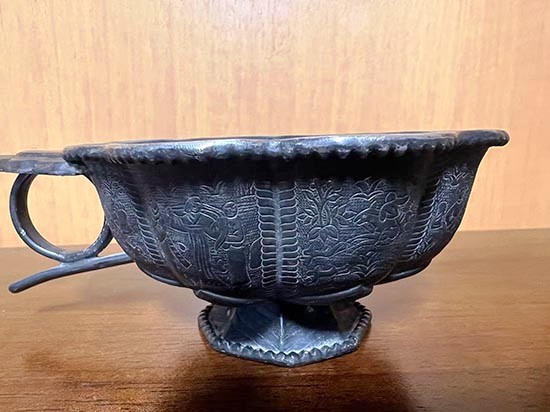
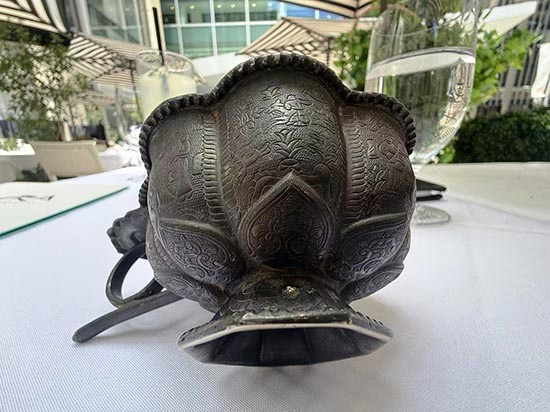
The artifact that impressed me most that day was an
eight-lobed Tang Dynasty gilt silver cup decorated with
court ladies and hunting scenes. Dr. Ye explained that two
of the most famous examples of this type are known today:
one excavated from the Hejia Village hoard in Xi’an and now
housed in the Shaanxi History Museum, and another unearthed
at Maqizhai in Xi’an and now preserved by the Xi’an Museum.
One is gilded, the other plain silver, yet both tell the
same story of
the Tang Empire.
The cup is divided into eight petals, alternating between
elegant court ladies and dynamic hunting scenes. Looking
closely at those miniature figures, I suddenly realized that
the images I had encountered in books were not literary
fantasies. The women rode horses, strolled through gardens,
danced, read, and participated actively in public life. They
belonged to an era that was confident, prosperous, and
remarkably open. The hunting scenes, meanwhile, reveal the
energy, strength, and grandeur of Tang aristocratic culture.
A silver cup less than ten centimeters tall somehow contains
an entire civilization.
As I studied it, one question kept returning to my mind:
Why did such an object emerge during the Tang Dynasty?
Why not another era?
The answer may lie within the nature of the Tang Empire
itself.
Thirteen hundred years ago, Tang China was among the most
prosperous, cosmopolitan, and internationally connected
civilizations on Earth. Chang’an, its capital, had a
population exceeding one million and was among the largest
cities in the world. Merchants from Central Asia, craftsmen
from Persia, monks from India, and students from Japan and
the Korean Peninsula all converged there. Some came to
trade, some to study, some to take the imperial
examinations, and others to serve in government.
Religious ideas, music, painting, architecture, and legal
institutions flowed across borders. Today we often think of
globalization as a modern phenomenon, but a visit to the
Tang world reveals that an earlier form of globalization
already existed. Chang’an was not simply the capital of
China; it was one of the great crossroads of Asian
civilization.
This gilt silver cup stands as a witness to that world. Its
shape reflects influences from Sogdian culture in Central
Asia. Its craftsmanship blends Eastern and Western
traditions. Yet its imagery depicts unmistakably Tang life.
Court ladies, hunting parties, banquets, and garden
gatherings together portray a society that was affluent,
open, and self-assured.
When we look at this cup, we are not simply looking at a
work of art. We are looking at an era—an era admired across
Asia, an era that attracted talent from every direction, an
era whose confidence allowed it to absorb and transform
influences from around the world.
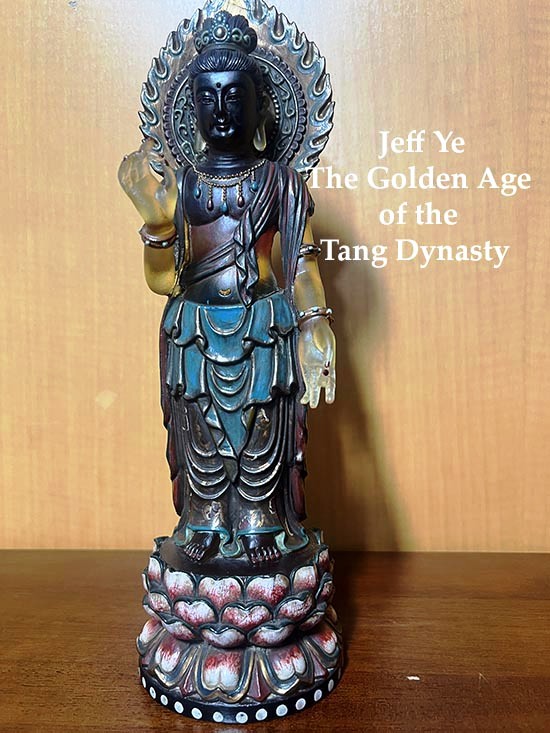
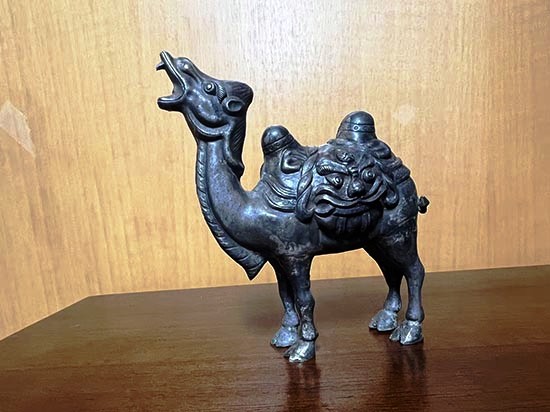
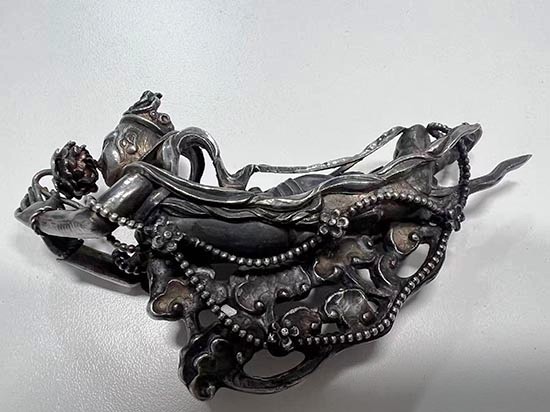
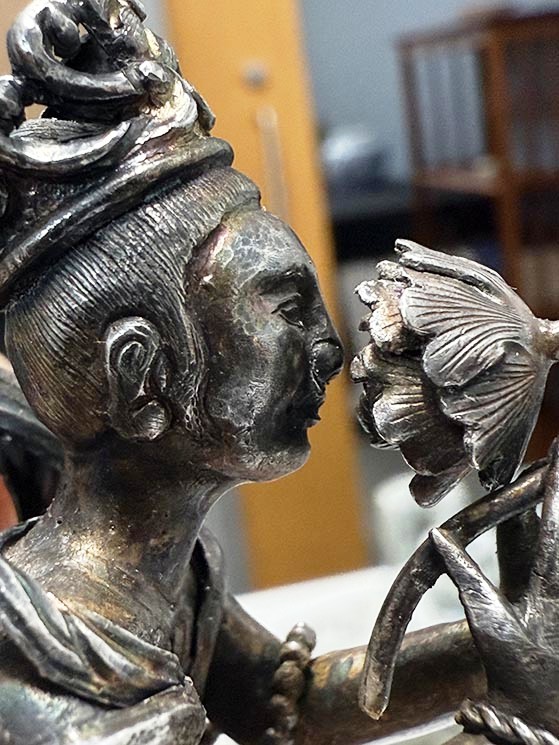
Later, Dr. Ye showed me two more objects: a Tang gilt Flying
Apsara
and a Silk Road camel.
Suddenly, I realized that together these three artifacts
formed a complete portrait of Tang civilization.
The Flying Apsara represents the sky and imagination—the
dreams of a civilization reaching beyond the known world.
The silver cup represents earthly life—the vitality and
richness of daily existence. The camel represents distant
horizons and global exchange—the Silk Road connecting China
with other civilizations.
Above, there are dreams. Below, there is prosperity.
Beyond, there is the world.
Perhaps this is the true greatness of the High Tang era. It
was not only powerful; it was open. It was not only wealthy;
it was creative.
The most fascinating moment of the afternoon occurred before
a Buddhist statue.
Also present in the office was an Indian financial expert
who had recently participated in a roughly $2 billion
real-estate project in the Philippines. Through Real World
Asset (RWA) tokenization, land had been digitized and
transformed into tradable financial assets, issued
simultaneously across five countries. Within just two weeks,
approximately one-third of the financing had been completed.
The remainder would be raised gradually as development
progressed, since large-scale luxury commercial and
residential projects do not require all capital upfront.
When Dr. Ye presented the Buddhist statue, the financier
immediately stopped, studied it carefully, and smiled.
“This is our culture,” he said.
At that moment, I thought of Journey to the West and the
pilgrimage of the monk Xuanzang. As children, we often
regard it as mythology. Yet suddenly I understood that it is
fundamentally a story about civilization.
Buddhism originated in India, traveled through Central Asia,
crossed the Silk Road, and ultimately became an essential
part of Chinese civilization. This statue belongs both to
India and to China. It tells not only the story of a nation
but also the story of how civilizations meet, exchange, and
transform one another.
For a brief moment, Chang’an, India, the Silk Road, and New
York
seemed connected by a single thread.
Our conversation naturally turned toward finance.
I asked the financier, “If land in the Philippines can
become a real-world asset, what about these cultural assets
left behind by the Tang Dynasty?”
His answer came without hesitation.
“Of course they are assets—and they are even rarer than
land. Land can be expanded through reclamation. A Tang
Dynasty sculpture can never be recreated. No matter how
advanced technology becomes, authenticity always leaves
traces that cannot be duplicated. Land records space.
Civilization records time. Land can be developed. History
cannot be reproduced. More land may exist tomorrow.
Tang artifacts will only become scarcer.”
When I finally left the UAJP office, New York was already
illuminated by evening lights. Yet several images remained
vivid in my mind: the ladies and hunters on the silver cup,
the flowing garments of the Flying Apsara, the camel
crossing the Silk Road, and the Indian financier holding the
Buddhist statue and quietly saying, “This is our culture.”
What surprised me most was how a small silver cup could
reveal such a vast world.
Through the cup, we glimpse the confidence and elegance of
Tang women. Through the cup, we see the openness and
prosperity of the Silk Road. Through the cup, we witness
Chang’an as a vibrant international metropolis. Through the
cup, we understand the transmission of Buddhism and the
fusion of civilizations. Through the cup, we observe the
continuous exchange between peoples and cultures.
And in a discussion held inside Rockefeller Center, we even
glimpse a new possibility: civilization as an asset class.
Perhaps truly great artifacts never belong solely to the
past. They are memories preserved by history, but they are
also questions posed to the future.
A single Tang Dynasty gilt silver cup connects Chang’an and
New York, the Silk Road and blockchain technology, ancient
civilization and the emerging financial world.
That may be its greatest fascination.
It also presents a profound challenge to those of us who
work in global finance: How can we build cultural heritage
funds, combine them with digital financial distribution
models, attract support from policymakers, banks, and
private equity investors, and create sustainable systems
where exhibitions, museums, financial products, and
educational programs work together?
The potential audience is not a city, a country, or a
region.
It is humanity itself—more than seven billion people.
If we can provide these artifacts with meaningful spaces for
preservation, exhibition, and appreciation, they can
continue telling our stories to future generations. Through
objects, history speaks.
After all, our own time in this world is limited. Yet these
Tang Dynasty treasures have already survived for more than
thirteen centuries—and may continue speaking long after we
are gone. |
| |
 |
| |
 |
| |
 |
| |
 |
| |
 |
| |
|
Additional Coverage
of Jeff Ye |
|
www.blacktiemagazine.com
Refined by Fire: The Inner Journey of Jeff Ye
|
 |
|
Jeff
Ye, Master Collector of Chinese
Antiquities |
|
|
|
Refined
by Fire:
The Inner Journey of Jeff Ye,
Master Collector of Chinese Antiquities
My life has been like a piece of
glazed glass,
sent again and again into the fire.
Jeff Ye
Report by: Dr. Jeannie Yi
|
|
|
|
|
|
|
Click Here to view the video if your
browser is not displaying
the English and Chinese captions |
|
|
At the beginning of 2026, a moment of
particular significance quietly took
place in New York, a city where art and
finance converge.
After years of anticipation
The International Institute of Art
Asset (IIAA)
was formally established.
Its importance reaches far beyond the
founding of another institution. For the
first time, a clear structural pathway
emerged for Eastern art to enter the
Western world—not merely as cultural
display, but as a system grounded in
valuation, legitimacy, and sustainable
commercial return. What had long existed
as aspiration was now becoming reality.
Throughout human history, the forms of
wealth have continuously transformed:
from gold and silver, to land, to
financial instruments, to luxury goods.
Yet among all these, only collecting
truly connects us to the roots of
civilization itself.
Collecting is often misunderstood as a
gesture of wealth or status. In truth,
it is an act of remembrance. Through
porcelain, jade, and bronze, we glimpse
the lives, values, and spirits of our
ancestors. Each artifact is not merely
an object, but a living fragment of
time.
Sitting across from me during this
interview was Jeff Ye, one of the
five co-founders of the International
Institute of Art Asset and the director
responsible for its antique and museum
collections.
In his hands, he held a remarkable
imperial
“Dragon Plate,”
inscribed with the phrase
“Mandated by Heaven.”
The object was overwhelming in its
presence.
This was not possession in the ordinary
sense. It was guardianship.
Jeff Ye owns thousands of such
treasures. His collecting journey has
taken him across China, from academic
research to remote regions, from
established markets to newly discovered
sites. Whenever news surfaced of an
unearthed artifact, he would go—without
hesitation.
What he collects is not defined by
money, but by responsibility.
Responsibility to history.
Responsibility to civilization.
This is where collecting transcends
wealth
and becomes a form of cultural
stewardship.
|
The glazed glass of the Spring and
Autumn and Warring States periods is
breathtaking in both color and form.
Perfectly round, crowned with a dragon,
it carries a blessing: auspiciousness,
peace, and harmony.
It is, in essence, China’s gift to the
world.
And it is also the spiritual origin of
the Art Asset Institute—
the mission of the descendants of the
dragon:
to protect, transmit, and honor
civilization.
For Jeff Ye, collecting has never
been defined by money.
It is defined by whether one is willing
to bear responsibility for civilization
itself.
When the Rockefeller family and the
Rockefeller Foundation traveled
repeatedly to China, they were certainly
not seeking oil deals or architectural
investments. They were searching for
treasures like those now resting on Jeff
Ye’s table—fragments of history that
allow future generations to see, with
their own eyes,
stories that began thousands of years
ago.
If collecting carries a certain
aristocratic spirit,
then this spirit takes many forms.
In Jeff Ye’s “aesthetic style of
collecting,”
I saw not luxury, but guardianship.
A guardian who has spent more than
thirty years
preserving cultural memory.
While managing real estate development
projects, he carved out rare time to
enter China’s once chaotic antique
markets, patiently watching them evolve
into systems of order. Again and again,
he searched—sometimes close to home,
sometimes across great distances
—for artifacts that carried the breath
of history.
At first, like many collectors, his
questions were simple:
“Is it beautiful?”
“Is it valuable?”
But gradually, his questions became
deeper:
Where did it come from?
Does it align with historical logic?
Can it withstand scientific scrutiny?
He once asked me quietly,
“Can its materials, craftsmanship,
patina, oxidation, perforations, and
color transformation endure both
scientific testing
and experiential judgment?”
I had no answer.
Though my own family had passed down
certain “treasures” through generations,
they lay untouched in cabinets
—unpriced, unrecognized, untradeable.
Jeff Ye, trained in chemistry,
understood that intuition alone was not
enough.
For collectors and enthusiasts alike, he
developed a rigorous system:
a twenty-criteria methodology for jade
authentication that moves from instinct
to science—
now known as the “Ye Standard.”
He said:
“Forgery in antiques is actually a false
concept.
Only time leaves irreversible marks.
To claim something can be perfectly
forged
is to claim time itself can be reversed.
Anyone with basic logic knows this is
impossible.”
In Jeff Ye’s system, the first judgment
is never data—it is breath.
Not reports, but whether the object
possesses a soul.
He believes in eye connection.
He believes in touch.
He believes in the intelligence stored
within the body
through years of experience.
For him, collecting is not ownership—it
is encounter.
A meeting between human and artifact,
guided by fate.
Much like love itself: different in
form, universal in essence.
That love pushed him to unite
aesthetics, history, chemistry,
microscopic observation, and instrument
testing.
To synchronize intuition with science.
In his world, collecting becomes a true
“cultural science”—
and an inheritance of love.
Not merely feeling,
but a civilization authentication
system.
From instinct and romance,
to verification and responsibility.
Like glazed glass itself,
his life has been shaped by fire—
again and again refined,
until clarity became light. |
|
|
 |
 |
 |
|
|
 |
|
|
 |
|
|
 |
 |
 |
 |
 |
 |
|
Additional Black Tie Featured Articles -
Jeff Ye |
|
|
|
www.blacktiemagazine.com
Jeff Ye - From New York to the Desert of Gold |
 |
Jeff Ye,
Master Collector of Chinese Antiquities
From New York to the Desert of
Gold
A Journey Where Vision Found Its Geography
By Dr. Jeannie Yi |
|
|
|
www.blacktiemagazine.com
Jeff Ye, World
Speakers Series, Trump Tower, NYC |
 |
|
Elvis Newman, Jeff Ye, World
Speakers Series, Trump Tower, NYC |
Jeff Ye, World
Speakers Series, Trump Tower, NYC
Love Letter to Life: Yongzheng and His Porcelain
When Civilization Blossomed Like a Flower
Report by: Dr. Jeannie Yi |
|
|
|
www.blacktiemagazine.com
Jeff Ye:
The Man Who Put Time on the Table |
 |
Gerard Mc Keon,
Publisher, Black Tie International Magazine
Jeff Ye, Master Collector of Chinese Antiquities |
| |
|
|
| |
|
|
Back To Society News |
|
| |
|