Black Tie
International Magazine China 1
2 3
4
www.blacktiechina.com
|
|
Share this page with your friends |
|
|
www.blacktiemagazine.com
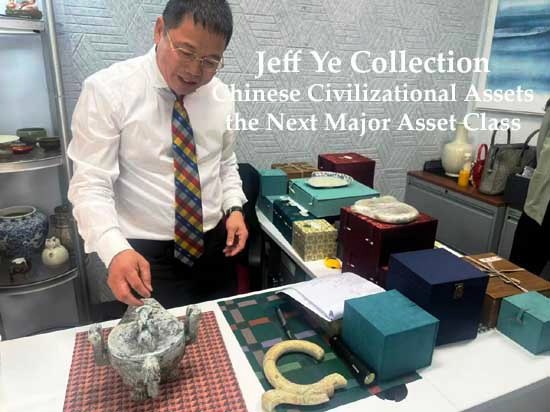
Jeff Ye Collection: Chinese Civilization Assets the Next
Major Asset Class
|
 |
|
|
Jeff Ye Collection:
Chinese Civilization Assets
the Next Major Asset Class |
Why Should Investors
Pay Attention to UAJP?
Chinese Civilizational Assets the Next Major Asset Class
Investment history suggests that some of the greatest
opportunities emerge when entirely new asset classes are
created. The securitization of real estate gave rise to the
REIT market. Gold ETFs transformed the way investors access
precious metals. Venture capital fueled the growth of the
technology sector. Digital currencies created an entirely
new category of digital assets.
Today, another potentially significant market remains in its
early stages:
The market for civilizational assets.
China possesses one of the richest cultural heritage
traditions in the world. Thousands of years of continuous
civilization have produced an immense body of artworks,
antiquities, historical artifacts, and cultural treasures.
Yet despite their significance, these assets have
historically faced three fundamental challenges. Limited
liquidity. High barriers to participation. Restricted global
accessibility and awareness. UAJP seeks to address these
challenges.
From an investment perspective, the potential value of UAJP
does not rest on any single artifact. Rather, it is built
upon the convergence of five distinct layers of value.
The first is scarcity value. The finest Chinese
civilizational assets are inherently finite. They cannot be
reproduced, and they cannot be manufactured again. Time
itself serves as the ultimate barrier to entry.
The second is civilizational value.
As global understanding of Chinese history, culture, and
heritage continues to expand, the international visibility
and cultural significance of these assets may increase
accordingly.
The third is network value. Collectors, museums,
foundations, family offices, academic institutions, and
digital asset investors are increasingly becoming part of a
broader ecosystem centered around cultural heritage and
preservation.
The fourth is liquidity value. Digital infrastructure has
the potential to introduce levels of global participation
and accessibility that have historically been unavailable
within traditional collecting markets.
The fifth is first-mover value. History repeatedly
demonstrates that participants who engage during the
formative stages of a new asset class often capture the
greatest long-term opportunities.
For this reason, paying attention to UAJP is not simply
about following a collection of artifacts.
It is about observing whether an entirely new market
category is beginning to emerge.
If, over the next decade, Chinese civilizational assets
become an increasingly recognized component of global
capital markets, then today’s participants may find that
they were not merely investing in individual objects.
They were participating in the creation of a new industry.
And like every major asset class before it, the most
significant value may be created long before the broader
market fully recognizes its existence.
|
|
|
 |
|
|
The Ultimate
Vision of UAJP
From Twenty-Five Cultural Treasures
to a $10 Billion Cultural Asset Platform
Many of the world’s most influential platforms began as
seemingly modest projects. Amazon, started as an online
bookstore. .Alibaba, began as a business-to-business
marketplace.
Tesla initially sold only a small number of vehicles.
What ultimately mattered was never the starting point.
It was the destination.
Today, UAJP begins with twenty-five significant Chinese
civilizational assets. Its long-term ambition, however,
extends far beyond these initial works, The vision is to
build the world’s first comprehensive platform dedicated to
Chinese civilizational assets. A platform where collecting,
scholarship, education, exhibitions, digitization, and
capital markets are integrated into a single ecosystem for
the first time.
In its mature form, UAJP may encompass five interconnected
pillars.
The first is Civilizational Asset Management.
The second is Civilizational Digitization.
The third is Civilizational Education.
The fourth is a Global Exhibition Network.
The fifth is Civilizational Finance.
Together, these pillars form a complete and self-reinforcing
ecosystem. Within such an ecosystem, a Hongshan jade dragon
is no longer merely a collectible artifact. It becomes
educational content It becomes the centerpiece of an
exhibition. It becomes a subject of academic research. And
it becomes a cultural asset for the digital age.
The same transformation applies to a Han Dynasty jade
masterpiece, a Shang ritual vessel, or a Tang Dynasty gold
or silver object.
Each acquires a new life that extends beyond the boundaries
of the traditional collecting market.
For this reason, UAJP’s ultimate goal is not to own the
largest number of artifacts. Its goal is to become a
critical piece of infrastructure for Chinese civilization in
the digital era. For the past five thousand years, Chinese
civilization has preserved itself primarily through physical
objects.
Over the next fifty years, however, that same civilization
may increasingly be transmitted through digital networks,
global capital markets, and mechanisms of cross-cultural
participation.
UAJP seeks to serve as the bridge between these two eras.
The journey begins with twenty-five artifacts. The
destination is a civilizational asset ecosystem valued at
ten billion dollars.
This is more than a business plan. It is a long-term
civilizational project.
Because the greatest forms of wealth have never belonged
solely to those who possess them.
They belong to those who understand their significance.
And the greatest civilizations should not remain hidden in
vaults and private collections.
|
|
|
 |
|
|
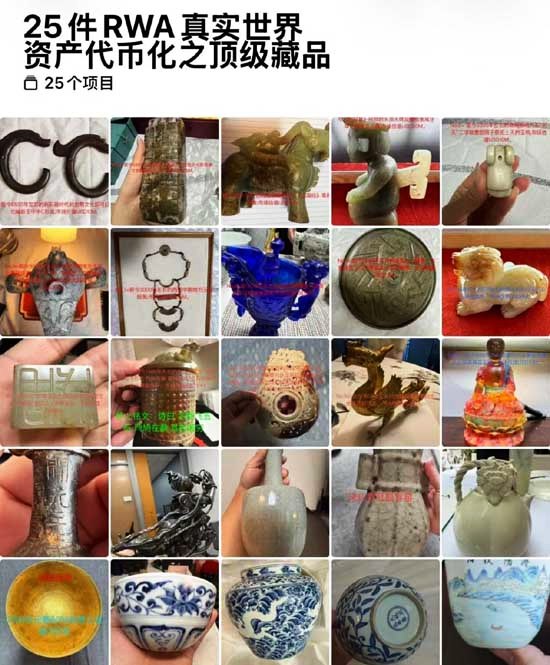
Twenty-Five
Ancient Chinese Masterpieces:
Twenty-Five Cultural Coordinates
Across the Long River of Chinese Civilization
When people encounter an ancient work of art,
the first question they often ask is simple:
How much is it worth?
For collector Dr. Jeff Ye, however,
the more important question has always been different:
What does it prove?
For more than three decades, his work has never been merely
about collecting Chinese antiquities. It has been about
searching for the tangible evidence left behind by history
itself. As he often says,
“Let the objects speak.”
Written records can disappear. Historical accounts may be
incomplete. Interpretations change from generation to
generation. Yet the objects themselves remain. Preserved
across centuries and millennia, they continue to reveal the
technological achievements, aesthetic ideals, social
structures, and spiritual beliefs of the civilizations that
created them.
This philosophy lies at the heart of the twenty-five
masterpieces
selected for the inaugural UAJP Digital Asset Portfolio.
They are not twenty-five randomly assembled antiques.
Nor are they twenty-five objects chosen solely for their
market value.
Together, they form a continuous timeline spanning more than
five thousand years of Chinese civilization. Each object
represents a distinct cultural coordinate—a fixed point
along the historical journey of one of the world’s oldest
continuous civilizations.
The story begins with the jade dragons of the Hongshan
Culture more than five thousand years ago. Within these
remarkable carvings are some of the earliest expressions of
Chinese spirituality, cosmology, and humanity’s relationship
with heaven and earth.
By the Liangzhu and Longshan periods, increasingly
sophisticated ritual systems had emerged. Jade bi discs,
cong tubes, and ceremonial objects reflected the rise of
organized society, social hierarchy, and cultural order.
During the Shang and Zhou dynasties, Chinese bronze
civilization reached extraordinary heights. A bronze vessel
was never merely an artwork. It represented the most
advanced technology of its age, requiring expertise in
mining, metallurgy, alloy formulation, high-temperature
casting, engineering, and large-scale organizational
coordination.
In many ways, a bronze ritual vessel from three thousand
years ago was the high technology product of its time.
With the emergence of a unified empire, Han Dynasty jade
carvings and imperial ritual objects demonstrated
increasingly sophisticated artistic and manufacturing
systems. During the Tang Dynasty, gold, silver, and
glassware reflected one of the most cosmopolitan and
internationally connected periods in Chinese history.
Subsequent dynasties—including Liao, Song, Yuan, Ming, and
Qing—each contributed new artistic languages and aesthetic
innovations. Jade, bronze, glass, gold, silver, and
porcelain evolved continuously across centuries, creating an
unbroken cultural dialogue between generations.
Dr. Ye often emphasizes that the true significance of a
collection does not lie in individual masterpieces alone,
but in the historical relationships
that connect them.
A single object may illuminate an era.
A group of objects may illuminate a chapter of history.
A complete collection, however, can illuminate the
developmental trajectory of an entire civilization.
For this reason, he proposes a perspective that differs
fundamentally from conventional collecting.
These works should not be viewed as twenty-five isolated
antiques.
They should be understood as twenty-five cultural
coordinates positioned across the long river of Chinese
history.
This distinction also defines what makes the UAJP initiative
fundamentally different from traditional art investment
projects.
UAJP is not simply digitizing antiques.
Nor is it merely converting artworks into tokens.
Its broader mission is to use digital technology and global
distribution networks to make authentic historical evidence
accessible to a wider audience, enabling people around the
world to engage directly with the cultural achievements
embodied within these objects.
In Dr. Ye’s view, the greatest value of Chinese antiquities
has never been confined to market price alone.
Their significance exists simultaneously across multiple
dimensions.
They possess historical value.
They embody technological achievement.
They preserve cultural memory.
They represent artistic accomplishment.
They express enduring aesthetic ideals.
A great Chinese antiquity is at once a work of art and a
historical document; a technological achievement and a
cultural statement.
Only when these objects are viewed together along a shared
timeline can one truly understand how Chinese civilization
developed, adapted,
and flourished across five millennia.
For this reason, the UAJP Digital Asset Portfolio
is not simply a collection of antiques.
It is a documentary of civilization told through physical
evidence.
It is a visual and scholarly journey that showcases the
historical, technological, cultural, artistic, and aesthetic
achievements of China through authentic surviving objects.
For the modern world, these twenty-five masterpieces offer
more than a glimpse into the past.
They provide a framework for understanding the roots of
Chinese civilization itself.
And when these twenty-five cultural coordinates are
connected, what emerges is no longer a collection.
It becomes a map.
A map tracing more than five thousand years of continuous
Chinese cultural and artistic development.
Perhaps that is the most powerful expression of
Dr. Ye’s enduring philosophy:
Let the objects speak.
|
|
|
Additional Coverage
of the
Jeff Ye Collection |
|
|
|
www.blacktiemagazine.com
Refined by Fire: The Inner Journey of Jeff Ye |
 |
|
Jeff
Ye, Master Collector of Chinese
Antiquities |
|
|
|
Refined
by Fire:
The Inner Journey of Jeff Ye,
Master Collector of Chinese Antiquities
My life has been like a piece of
glazed glass,
sent again and again into the fire.
Jeff Ye
Report by: Dr. Jeannie Yi
|
|
|
|
|
|
|
Click Here to view the video if your
browser is not displaying
the English and Chinese captions |
|
|
At the beginning of 2026, a moment of
particular significance quietly took
place in New York, a city where art and
finance converge.
After years of anticipation
The International Institute of Art
Asset (IIAA)
was formally established.
Its importance reaches far beyond the
founding of another institution. For the
first time, a clear structural pathway
emerged for Eastern art to enter the
Western world—not merely as cultural
display, but as a system grounded in
valuation, legitimacy, and sustainable
commercial return. What had long existed
as aspiration was now becoming reality.
Throughout human history, the forms of
wealth have continuously transformed:
from gold and silver, to land, to
financial instruments, to luxury goods.
Yet among all these, only collecting
truly connects us to the roots of
civilization itself.
Collecting is often misunderstood as a
gesture of wealth or status. In truth,
it is an act of remembrance. Through
porcelain, jade, and bronze, we glimpse
the lives, values, and spirits of our
ancestors. Each artifact is not merely
an object, but a living fragment of
time.
Sitting across from me during this
interview was Jeff Ye, one of the
five co-founders of the International
Institute of Art Asset and the director
responsible for its antique and museum
collections.
In his hands, he held a remarkable
imperial
“Dragon Plate,”
inscribed with the phrase
“Mandated by Heaven.”
The object was overwhelming in its
presence.
This was not possession in the ordinary
sense. It was guardianship.
Jeff Ye owns thousands of such
treasures. His collecting journey has
taken him across China, from academic
research to remote regions, from
established markets to newly discovered
sites. Whenever news surfaced of an
unearthed artifact, he would go—without
hesitation.
What he collects is not defined by
money, but by responsibility.
Responsibility to history.
Responsibility to civilization.
This is where collecting transcends
wealth
and becomes a form of cultural
stewardship.
|
The glazed glass of the Spring and
Autumn and Warring States periods is
breathtaking in both color and form.
Perfectly round, crowned with a dragon,
it carries a blessing: auspiciousness,
peace, and harmony.
It is, in essence, China’s gift to the
world.
And it is also the spiritual origin of
the Art Asset Institute—
the mission of the descendants of the
dragon:
to protect, transmit, and honor
civilization.
For Jeff Ye, collecting has never
been defined by money.
It is defined by whether one is willing
to bear responsibility for civilization
itself.
When the Rockefeller family and the
Rockefeller Foundation traveled
repeatedly to China, they were certainly
not seeking oil deals or architectural
investments. They were searching for
treasures like those now resting on Jeff
Ye’s table—fragments of history that
allow future generations to see, with
their own eyes,
stories that began thousands of years
ago.
If collecting carries a certain
aristocratic spirit,
then this spirit takes many forms.
In Jeff Ye’s “aesthetic style of
collecting,”
I saw not luxury, but guardianship.
A guardian who has spent more than
thirty years
preserving cultural memory.
While managing real estate development
projects, he carved out rare time to
enter China’s once chaotic antique
markets, patiently watching them evolve
into systems of order. Again and again,
he searched—sometimes close to home,
sometimes across great distances
—for artifacts that carried the breath
of history.
At first, like many collectors, his
questions were simple:
“Is it beautiful?”
“Is it valuable?”
But gradually, his questions became
deeper:
Where did it come from?
Does it align with historical logic?
Can it withstand scientific scrutiny?
He once asked me quietly,
“Can its materials, craftsmanship,
patina, oxidation, perforations, and
color transformation endure both
scientific testing
and experiential judgment?”
I had no answer.
Though my own family had passed down
certain “treasures” through generations,
they lay untouched in cabinets
—unpriced, unrecognized, untradeable.
Jeff Ye, trained in chemistry,
understood that intuition alone was not
enough.
For collectors and enthusiasts alike, he
developed a rigorous system:
a twenty-criteria methodology for jade
authentication that moves from instinct
to science—
now known as the “Ye Standard.”
He said:
“Forgery in antiques is actually a false
concept.
Only time leaves irreversible marks.
To claim something can be perfectly
forged
is to claim time itself can be reversed.
Anyone with basic logic knows this is
impossible.”
In Jeff Ye’s system, the first judgment
is never data—it is breath.
Not reports, but whether the object
possesses a soul.
He believes in eye connection.
He believes in touch.
He believes in the intelligence stored
within the body
through years of experience.
For him, collecting is not ownership—it
is encounter.
A meeting between human and artifact,
guided by fate.
Much like love itself: different in
form, universal in essence.
That love pushed him to unite
aesthetics, history, chemistry,
microscopic observation, and instrument
testing.
To synchronize intuition with science.
In his world, collecting becomes a true
“cultural science”—
and an inheritance of love.
Not merely feeling,
but a civilization authentication
system.
From instinct and romance,
to verification and responsibility.
Like glazed glass itself,
his life has been shaped by fire—
again and again refined,
until clarity became light. |
|
|
 |
 |
 |
|
|
 |
|
|
 |
|
|
 |
 |
 |
 |
 |
 |
|
Additional Black Tie Featured Articles -
Jeff Ye |
|
|
|
www.blacktiemagazine.com
Jeff Ye - From New York to the Desert of Gold |
 |
Jeff Ye,
Master Collector of Chinese Antiquities
From New York to the Desert of
Gold
A Journey Where Vision Found Its Geography
By Dr. Jeannie Yi |
|
|
|
www.blacktiemagazine.com
Jeff Ye, World
Speakers Series, Trump Tower, NYC |
 |
|
Elvis Newman, Jeff Ye, World
Speakers Series, Trump Tower, NYC |
Jeff Ye, World
Speakers Series, Trump Tower, NYC
Love Letter to Life: Yongzheng and His Porcelain
When Civilization Blossomed Like a Flower
Report by: Dr. Jeannie Yi |
|
|
|
www.blacktiemagazine.com
Jeff Ye:
The Man Who Put Time on the Table |
 |
Gerard Mc Keon,
Publisher, Black Tie International Magazine
Jeff Ye, Master Collector of Chinese Antiquities |
| |
|
|
| |
|
|
Back To Society News |
|
| |
|