|
Dr.
Judy Kuriansky |
|
Share this page with your friends |
|
|
www.blacktiemagazine.com
Dr. Judy Kuriansky:
ReproEco:Tomorrow Is
Now |
|
|
 |
|
Dr. Judy Kuriansky |
|
Black Tie International Magazine,:
ReproEco:Tomorrow Is
Now |
ReproEco:Tomorrow Is
Now
Theater
Confronts Environmental and Reproductive Justice
A groundbreaking New York production unites drama, dance,
film and music to illuminate the intimate human consequences
of environmental harm
|
|
|
 |
|
|
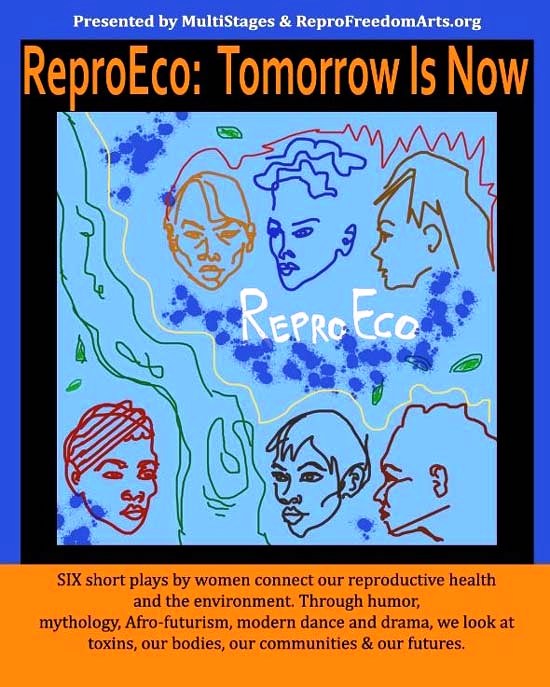
A stunning new
must-see theatrical production entitled
ReproEco: Tomorrow is Now confronts social justice
and women’s’ reproductive health in six thought-provoking
plays interspersed with dance, original music and immersive
film projection.
The stories are compelling and demand action to save people
and the planet.
One of the six works takes place in Sandbranch, Texas—a
community established by formerly enslaved people after the
Civil War—where the roughly 80 remaining low-income,
predominantly Black residents have lived with polluted water
wells and without clean running water, sewage systems, or
trash pickup.
The painful reality of such conditions is the setting of
Always Never Really Here, a poignant short play by
writer, actor and producer Alinca Hamilton. In the story,
dreams clash. A mother works tirelessly to fulfill her dream
of saving her community by collecting and distributing
donated water, when her high-school-age daughter suddenly
announces that she intends to leave home to attend college
in New York.
“You know what I dream about?” the daughter asks her mother.
“Standing up and taking a shower. Turning on a faucet.
Letting water hit my face. Letting water run, Mom.” |
|
|
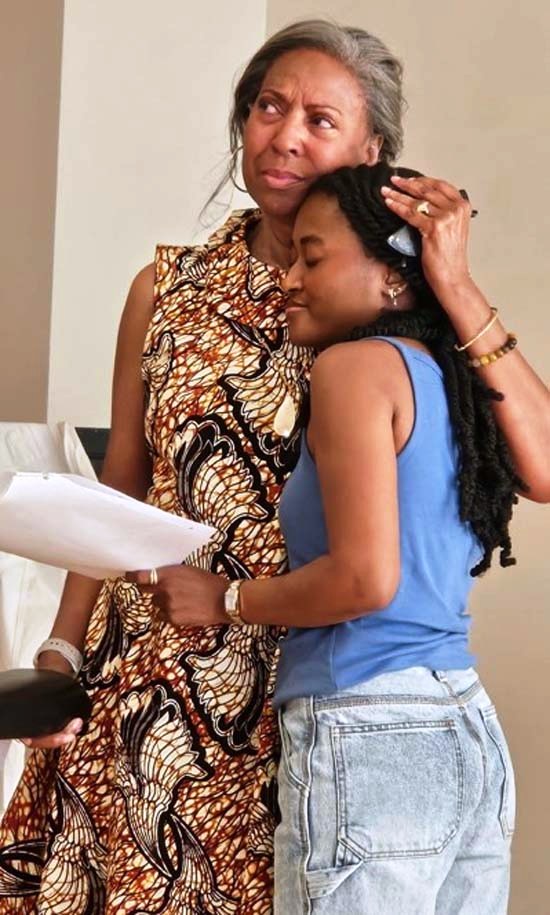 |
Gena
Bardwell and Brielle Webb as mother and daughter in
rehearsal for Alinca Hamilton’s “Always Never Really Here”
(Photo credit: Lilliana Esposito) |
|
|
|
The mother-daughter
exchange is heartbreaking because people around the world
live in similar dire conditions, where clean, running
water—which most of us take for granted—becomes a symbol of
health, human dignity and freedom. |
|
|
 |
|
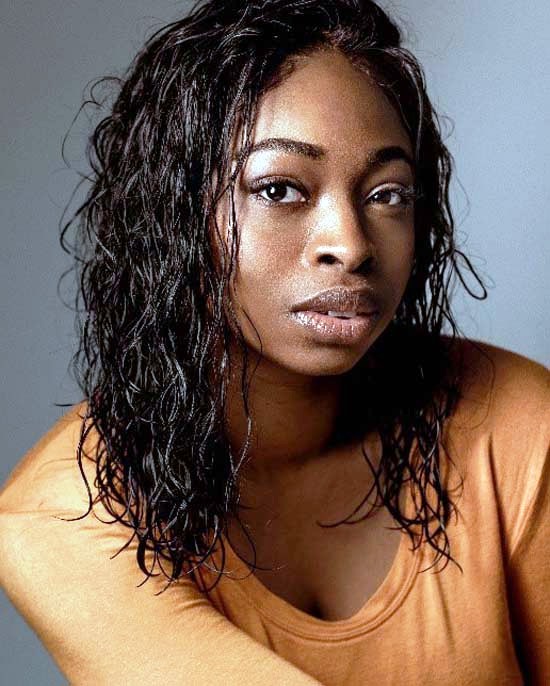
Playwright Alinca
Hamilton (Photo credit: Mel Ashby) |
|
|
|
The message is
powerful about how polluted water, toxic chemicals,
contaminated air, microplastics, and environmental
degradation affect human health—particularly of women.
Appropriately, the production’s title ReproEco is a
portmanteau for Reproductive Freedom and Environmental
Ecology (or Environmental Justice). |
|
|
 |
|
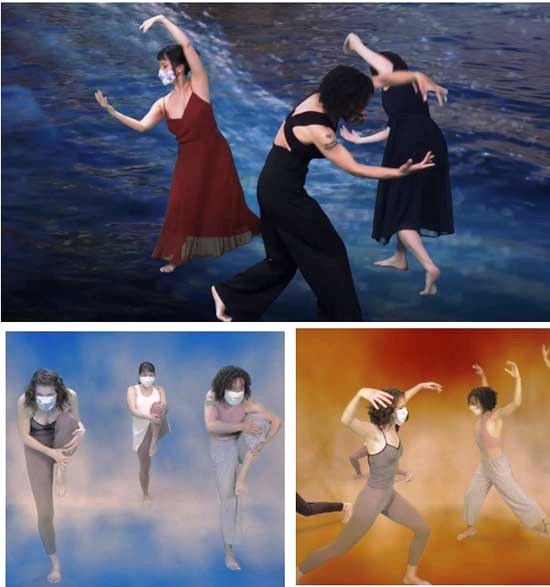
Dances “Breath”
and Water” in ReproEco, choreographed by Jennifer Chin
(Photo credit: L. Fusco) |
|
|
|
The production is a
collaboration of MultiStages with ReproFreedomArts.org. In
its 24th year, MultiStages, founded by award-winning
theatrical producer Lorca Peress, is known for
multidisciplinary, multicultural theater addressing socially
consequential subjects. ReproFreedomArts.org, founded by
award-winning playwright and journalist Cindy Cooper, has
spent 24 years advancing reproductive freedom, health,
rights and justice through theater and the arts. |
|
|
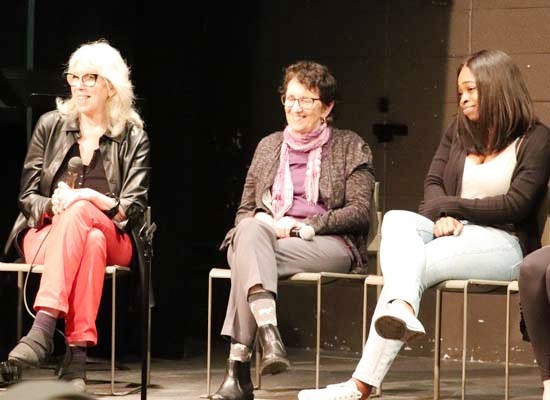 |
Talkback at
Goddard Riverside, New York City (left to right) Lorca
Peress,
Cindy Cooper and Alinca Hamilton (Photo Credit; L. Fusco) |
|
|
|
“We use a
multi-textured unique mix of drama, humor, music, mythology,
mystery and Afrofuturism to engage audiences in how artists
can bring imagination, emotional force, and storytelling to
urgent questions of human rights,” explains Peress.
Afrofuturism is a cultural movement that blends Black
history and culture with science, technology, and the
future. Through speculative fiction, art, and music, it
explores how the experiences of Black ancestors can affect
choices facing future generations, asking audiences to
consider what kind of planet we are creating and what
obligations we have to those who will inherit it.
Black identity and survival are prominent in the production.
Half of the six playwrights are Black, and several of the
plays feature Black characters facing challenges that apply
particularly to Black women with themes about how polluted
water, toxic chemicals, contaminated air, microplastics and
environmental degradation affect their health.
In fact, African women are severely affected by
environmental toxins for several reasons, including that
their work roles traditionally expose them to household
smoke, polluted water, and industrial pollution, leading to
high rates of chronic illness, reproductive complications,
and even premature death. They are also less likely to be
able to access affordable healthcare
For ReproEco, six women playwrights from diverse backgrounds
were invited to study the relationship between reproductive
health and environmental justice and transform their
findings into original dramatic works.
|
|
|
 |
|
|
ReproEco
arrives at an especially meaningful political moment,
coinciding with the 81st session of the United Nations
General Assembly (UNGA) in September, when representatives
of the United Nation’s 193 Member States (governments)
gather to discuss these very most pressing challenges
affecting the world.
Coincidentally, the timing also overlaps with UNGA’s Healing
Arts Week and Climate Week, placing the production within a
broad international conversation about health, climate, and
human well-being. The Healing Arts Week, presented by the
Jameel Arts and Health Lab in collaboration with the World
Health Organization (WHO), brings together artists,
researchers, health professionals and policymakers to
explore how creative expression can contribute to individual
and collective well-being. It was co-founded by Nisha
Sajnani, PhD, Nils Fietje, PhD, Stephen Stapleton, and
Christopher Bailey, whom I know from his participation in an
event I co-produced at the UN, where he presented his
one-man play about having visual challenges.
The production of ReproEco: Tomorrow Is Now
particularly appeals to me for many reasons. First, for its
connection to the UN global agenda, since during my 23 years
of involvement with the United Nations, I have advocated for
the rights of women and girls, environmental protection, and
the Sustainable Development Goals. (SDGs). The play overlaps
with several SDGs (e.g., about health, water and sanitation,
climate action, and the environment)
The production is an example to me of “cultural diplomacy”
which I champion: the use of art to deepen international
understanding, stimulate emotional connection to distant
crises, give a human face to policy debates, encourage
dialogue, and advance peace, where traditional political
rhetoric cannot. As a co-founder of Women4Diplomacy
International, with the former Ambassador of Hungary to the
UN, Katalin Bogyay, newly appointed Chair of the Hungarian
National Commission for UNESCO, I will travel to Budapest
for our annual Art4Peace event on September 7. |
|
|
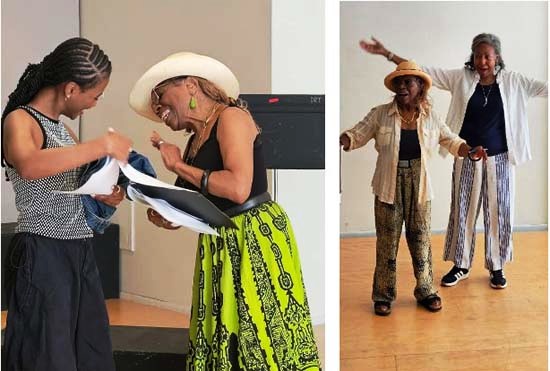 |
Rehearsal of the
play “We Are Our Ancestors Reasons for Living”
(Photo credit: Cindy Cooper) |
|
|
The connection
between ReproEco and the UN’s global agenda is
particularly clear in one of the plays, Always Never Really
Here. Water, sanitation and hygiene—widely known by the
acronym WASH—are central to the UN Sustainable Development
Goal 6, which calls for clean water and sanitation for all
by the year 2030.
Also, when I attended the annual meeting of the African
Union in Addis Ababa, Ethiopia, last February, the group
voted to make its annual theme about water and sanitation.
Further, a friend of mine, Dr. Adaeza Okika, is a Senior
Adviser and Deputy Permanent Observer of Water and
Sanitation for Africa, an intergovernmental and civil
society organization cooperating with the UN.
Furthermore, I have long supported the work of Peress, a
good friend, fellow champion of social causes and women’s
health, and member of the League of Professional Theatre
Women.
Moreover, I am attracted to the plays about Africa, having
much experience on the continent. I co-produced a Girls
Empowerment Camp in Lesotho; did AIDS advocacy with groups
of African youth; conducted psychosocial workshops during
natural and man-made disasters in Africa including pandemics
like Ebola and Covid-19; serve as advisor to the Mission of
Sierra Leone at the UN and for six years as policy advisor
to His Excellency Sidique Wai, Ambassador of Sierra Leone to
the United States; serve on the board of the United African
Congress; co-produce many events about Africa issues; and
contribute articles to the Africa edition of Business
Traveler Magazine.
“You can’t tell the story of America without the
perseverance of Black folks,” adds Hamilton, who has
collaborated on work at the International Black Theatre
Festival. “Even through a struggle to obtain clean water,
they find moments of joy and courage to dream of a better
future.”
Resilience and courage facing struggle reverberate
throughout the plays in ReproEco.
In Afro-American playwright Cassandra Medley’s We Are Our
Ancestors’ Reasons for Living, an multigeneration of
women inhabit an Afrofuturist world in which the natural
environment has become so degraded that the outdoors can be
experienced only virtually. The four women in the play
travel to Ghana to the famous Elmina Castle to see the “Door
of No Return.”
In a dramatic scene, the mother character named Renee
declares, “Our descendants marched hundreds of miles in
chains to this castle, then branded like cattle…then forced
through the narrow 'Door of No Return' and onto them damn
slave ships.”
|
|
|
 |
|
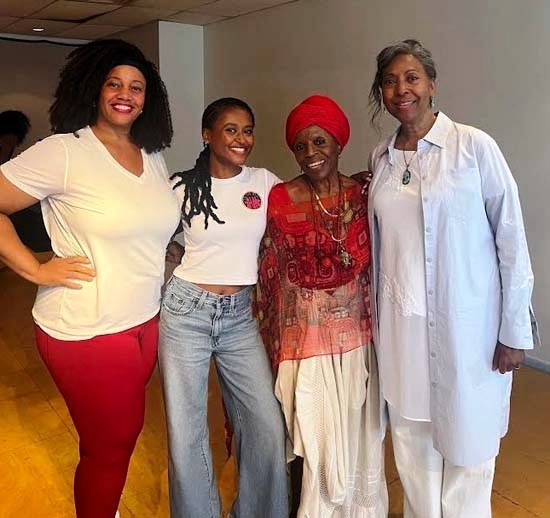
The four
intergenerational women in Cassandra Medley’s play “We Are
Our Ancestors Reasons for Living” during rehearsal at the
Vineyard Rehearsal Studio. (Photo Credit: Matthew White) |
|
|
|
Despite the drama,
the generations of women share joy. |
|
|
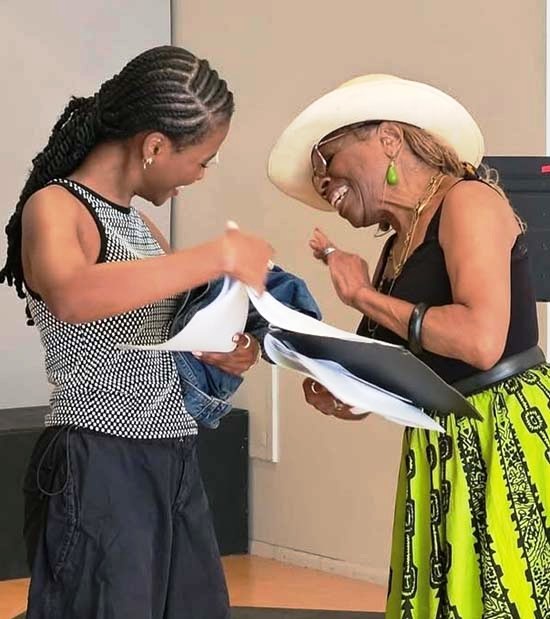 |
Celebrating the
Great-Great Granddaughter in Medley’s play in rehearsal,
with Brielle Webb and Joyce Griffen (Photo Credit M. Ashby). |
|
|
Pregnancy and
midwifery are important themes in the plays.
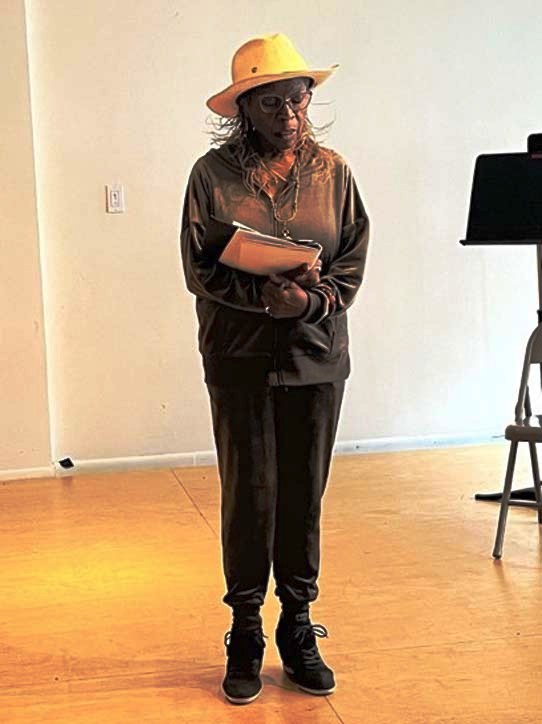
Playwright Laura Shamas offers a stark warning in Priorities, set
in a dystopian future, following two gynecologists and a
midwife meeting secretly to determine how their pregnant
patients can escape a toxic environment of wildfires. |
|
|
 |
|
Joyce Griffen in
Shamas’ dystopian play (Photo credit: M. Ashby) |
|
|
|
Drawing upon the
traditions of Black midwives whose knowledge and care
sustained generations of women in communities without
adequate medical care, award-winning writer Mildred Inez
Lewis presents, in her play Through Water Into Blood, the
story of Ellie, a Latina woman suffering a devastating
stillbirth (with the baby alive only a minute and 43
seconds), and her Black doula, who together ponder whether
toxic chemicals may have contributed to the tragic loss.
|
|
|
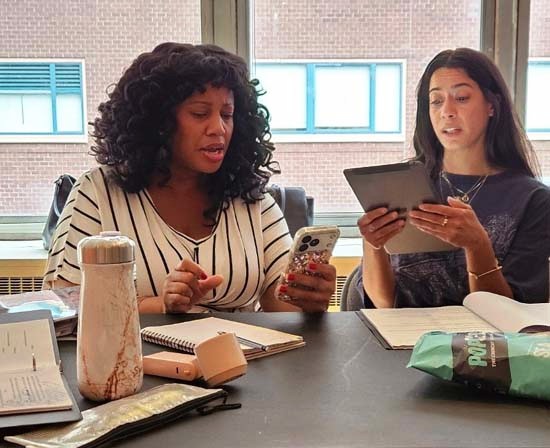 |
Rehearsal of
Lewis’ play “Through Water Into Blood” with distraught
mother and her doula (played by Pernell Walker and Darlenis
Duran
(Photo Credit: M. Ashby) |
|
|
In a dramatic moment
of desperation, Ellie attempts to climb back into the birth
tub to figure out what went wrong. Could it be because her
Afro-American husband works in a plastics plant, or did
chemicals in the water seep into her placenta?
Regardless of the exact cause, the health of future
generations is in danger from pollution.
Lewis intentionally set her play in her mom's birthplace of
West Virginia, “where our people are fighting climate change
everywhere in ways big and small.”
Author and journalist Cindy Cooper’s play Until the Change Comes
shines a critical light on corporate responsibility and
ethics. A young interracial consumer-branding team begins to
question its work after an imaginary encounter with Theo Colborn, the pioneering scientist who warned of the dangers
posed by endocrine-disrupting chemicals. |
|
|
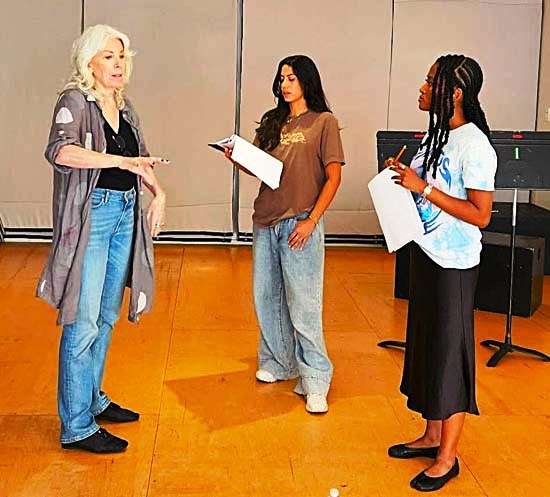 |
MultiStages
Artistic Director Lorca Peress directing Darlenis and
Brielle
in Cindy Cooper’s play “Until the Change Comes” (Photo
Credit: M. Ashby) |
|
|
|
While environmental
toxicity is serious, Diane Breser uses humor in her play Figments.
Inspired by her own children's expecting babies, Bresser
writes about a woman who confronts her fears about her
pregnancy in a comical nightmare populated by microplastics.
The play considers the small but meaningful steps expectant
parents can take to protect themselves and their children
without allowing anxiety to overwhelm the joy of welcoming
new life. |
|
|
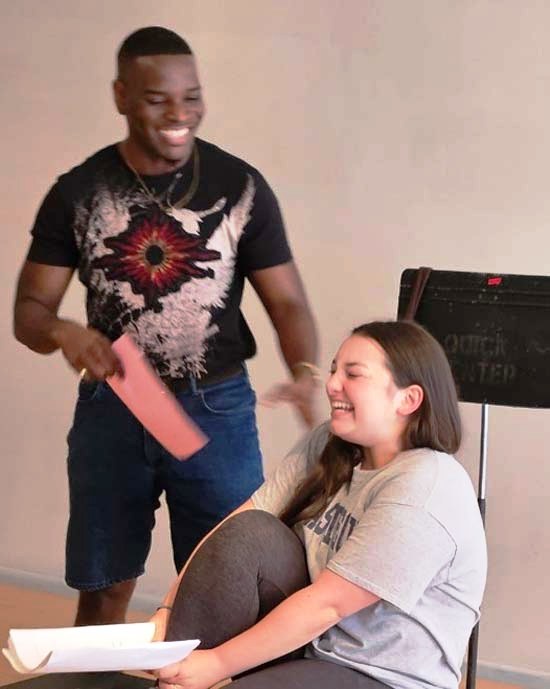 |
Rehearsal of
“Figments” with the couple, played by James Alton and
Becca Worthington, elated about the pregnancy (Photo credit: M. Ashby) |
|
|
|
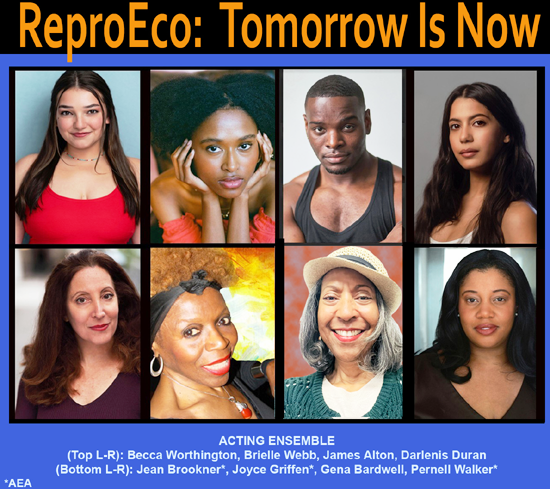
An ensemble of eight
actors perform all 19 roles. |
|
|
 |
|
|
|
The production’s
creative team are all women and female-identifying |
|
|
 |
|
|
|
As Peress reminds
us, “Theater is like families; it takes a village.” |
|
|
The production’s
subtitle, Tomorrow Is Now, purposefully invokes the
legacy of former First Lady, humanitarian, women’s rights
advocate, and co-author of the Declaration of Human Rights,
Eleanor Roosevelt, who wrote, “It is today that we must
create the world of the future… In a very real sense,
tomorrow is now.”
Roosevelt’s message inspires urgency presented in
ReproEco—that unsafe water, toxic poisons and
compromised human health must be addressed now.
As playwright Shamas said, “My play is a warning. Make these
issues a priority now, or soon it will be too late.”
ReproEco proves that theatre can play a crucial role
in social justice, particularly for, and by, women.
ReproEco: Tomorrow Is Now will present 12
performances from
September 9 through October 4, 2026,
at the Theater at the 14th Street Y,
344 East 14th Street, New York City.
For schedules, tickets and further information,
visit
https://multistages.org
or
reprofreedomarts.org/reproeco/
|
|
|
|
Bookmark Dr. Judy's Column on Black Tie International
Magazine
https://blacktiemagazine.com/Judy_Kuriansky/Judy_Kuriansky_Main_page.htm
|
|
|
|
|
| |
|
| |
|