|
Society News
1
2
3
4 5
6 |
|
Share this page with your friends |
|
|
www.blacktiemagazine.com
NYU News Doc Film Festival 2026
|
 |
|
Dr. Judy Kuriansky |
|
|

|
|
NYU News Doc Film Festival
2026
|
|
|
Qatari siblings
promote social justice
through a film documentary
and international development
By Dr. Judy Kuriansky |
|
|
As a young girl
growing up in Doha, Qatar, Aljawhara AlHedfa says she always
had a camera in hand, capturing every family trip and going
on iMovie to edit their experience as a memory for years
later.
Now, her documentary about a different family’s trip
premiered at
NYU News Doc Film Festival 2026,
a film festival of 12 graduate students’ work from the News
and Documentary master’s program at New York University. The
event took place at the Cantor Film Center in New York City
on February 6 and 7, 2026.
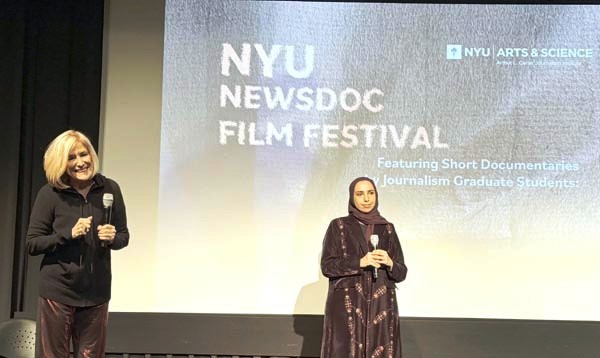
Introducing the festival, founder of the NewsDoc program,
Marcia Rock, professor and Director of News and Documentary
at the NYU Arthur Carter Journalism Institute, expressed how
proud she was of
“the wonderful international community of students.” |
|
|
 |
|
Festival founder
Marcia Rock introducing documentarian master’s student
Aljawhara AlHedfa |
|
|
The films themselves
covered international topics, from a Bdoul tribe from Petra,
Jordan, to the controversy over wild wolves roaming the
Dutch countryside, to an indigenous leader in the Ecuadorian
Amazon fighting gold mining companies from dumping deadly
chemicals in their rivers.
Aljawhara’s documentary, entitled “O Homeland We Are Back”
follows a family fulfilling their dream to return to their
home in Syria after escaping in 1982 from fears of political
and religious persecution to live in exile in Doha, Qatar.
The Assad regime was shaking down the Sunnis from practicing
freely. |
|
|
 |
|
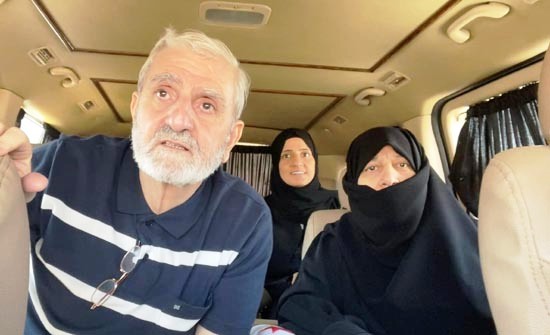
The family
featured in Aljawhara’s documentary |
|
|
The father, Dr.
Ameen AlHawari, a Ph.D. in Islamic law, teaches Islamic
studies. His wife keeps the home and their daughter, Lubaba,
now 37 years old, is a lecturer in Islamic Studies at Lusail
University in Doha and studying for her Ph.D. in Arabic
studies.
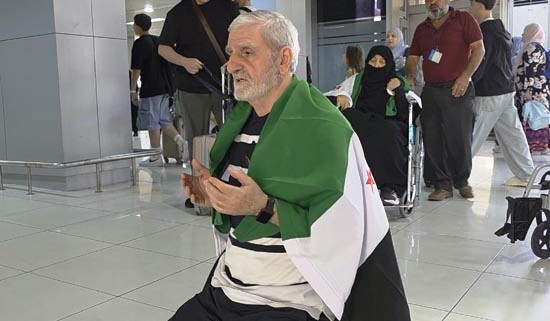
In a particularly emotional scene, when arriving at the
Damascus airport in Syria, Ameen dropped to his knees and
prayed, out of profound gratitude to return home. |
|
|
 |
|
Dr. Ameen
AlHawari, father of the family in the documentary, draped in
the Syrian flag, arriving at the Damascus airport. His wife
is behind in a wheelchair. |
|
|
“O homeland, we are
back regardless of all the hatred and we have prevailed
despite the betrayal and we rejoice as light shown from the
land of jasmine,” he told Aljawhara.
The mother, Bari’a, was emotional and teary throughout the
filming.
“I left at the age of 22 and now I’m 66,” she told Aljawhara.
“My legs can’t even walk. What did I do wrong to waste 43-44
years of my life outside my country? Displaced from one
country to another. In every country, ‘you’re an immigrant,
you’re an expat'…Why am I to blame?
What crime did I do to be a fugitive?”
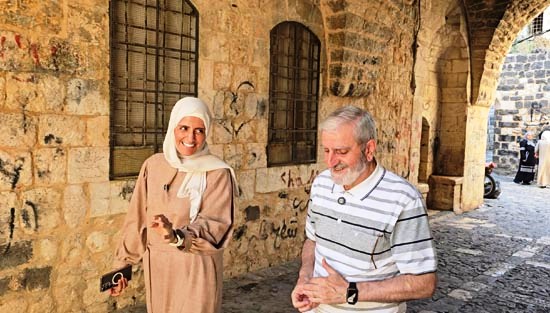
Lubaba always struggled with her identity since she had
never before visited her homeland. She told Aljawhara, “I
felt like I didn’t belong anywhere. To whom should I belong?
What’s my country? Until I grew older and understood the
concept of identity and belonging, I then developed
temporarily belonging to places and people.” |
|
|
 |
|
Lubaba and her
dad walking the streets of Damascus |
|
|
Telling their story
was as profound an experience for Aljawhara.
“I did a lot of crying,” she admits.
“It was such a privilege to be part of their life for a
couple of months and get to know them. I consider them a
second family. We went through so much together, especially
with the attacks on their country and not knowing whether
they can go back or not.”
With the number of refugees worldwide tracked as 42.5
million and growing as of mid-2025, Aljawhara’s documentary
applies to a wide audience.
“This story speaks so much not just for this family, but for
people around the world,” she told me. “I really care about
human rights stories and immigrants, as human beings, and
want to be sure these stories are heard.”
When searching for a story for her NYU graduation thesis, a
friend of Aljawhara introduced her to Lubaba in February
last year. The two first talked on zoom and then Aljawhara
met the family in person in Doha.
The parents were very hesitant at first to share their
story, being traumatized by living in exile. “But,” she told
me, “When I sat with them and explained my vision, they
agreed.”
Aljawhara herself went through much mental preparation, “I
did not want to trigger them. I had to do a lot of research
and agreed with them about what are the redlines, meaning
what I cannot ask”. |
|
|
Parts of what they
told her she promised not to reveal.
The plight of refugees is close to my heart. As a mental
health advocate at the United Nations for many years, I
worked with governments and members of the UN NGO Committee
on Migration to ensure that references to mental health and
wellbeing, resilience, psychosocial support, and counseling
were included in the Global Compact on Migration as well as
the Global Compact for Refugees. The success is recorded in
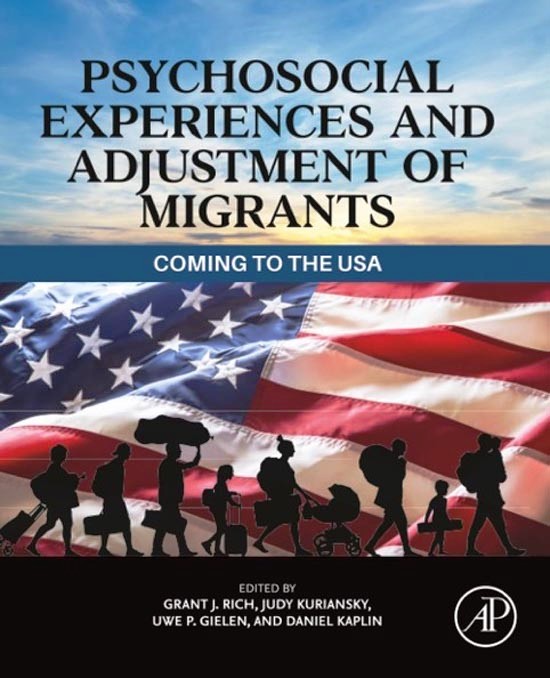
a chapter in a book I co-edited on“Psychosocial support for
migration and refugees:
Similarities and differences in historic international
Compacts”
in the book
“Psychosocial Experiences and Adjustment of Migrants:
Coming to the USA.” |
|
https://www.amazon.com/Psychosocial-Experiences-Adjustment-Migrants-Coming/dp/0128237945 |
|
|
 |
|
|
During those
negotiations, I made several presentations about the meaning
of “home” and the theory of “place attachment” that affords
a sense of safety, identity and belonging.
People move either by choice or being forced, due to several
factors: political (to escape war or political persecution,
as for the family in Aljawhara’s documentary); environmental
(after natural disasters); social (for improved quality of
life or to be closer to loved ones); or economic (employment
opportunities).
As a psychologist, I especially appreciate the emotional
challenges of moving, that are varied and can be extremely
traumatic, especially when involuntary or forced to live in
exile. Common are culture shock and culture bereavement,
losing familiar values, attitudes, language, support
systems, and cultural and social structures. In addition,
there can be confusion about identity, values, and role
expectations, and feelings of anxiety, anger, resentment,
and powerlessness.
The family profiled by Aljawhara fled their country 44 years
ago, although the major Syrian refugee crisis, considered
the worst since WWII, began in 2011 when an estimated 6
million citizens fled to neighboring Turkey, Lebanon and
Jordan due to the civil war and military efforts to stop
protests against the oppressive Assad regime.
Aljawhara’s own dream since childhood was always to film
people’s stories.
“My dad got me my first camera and for a school project I
made a short film, and my teacher said, ‘you should apply to
Northwestern University in Qatar’, where I studied media and
communications.”
After graduation, she became a teacher for two years of
12-13-year-olds through a program called “Teach for Qatar,”
a collaboration with the Qatar Ministry of Education.
Realizing she loved both teaching and film, she wondered,
“How can I do these together?” and came up with the idea to
study filmmaking at NYU’s master’s program.
Her degree under her belt, now at 27 years old, the very
next day after the screening and celebrating with her
classmates, she packed up her New York City apartment and
flew home to Doha, to a position teaching filmmaking at
Qatar University.
Her hero in cinema is Martin Scorsese -- an American
filmmaker considered one of Hollywood’s most influential
directors, whose films also explore themes of identity, and
who also got his master’s degree at NYU (but in the
department of Culture, Education and Human Development).
“I like his classic approach,” she says.
Friends attending the student film festival event were
moved.
“Her film that follows the family going home to Syria
captures the magical moment of someone’s dream coming true,
that doesn’t happen that often,” said friend Ruben Mena, a
law student working for the Princess Grace Foundation Guild
that supports young artists in film, theatre, and dance. |
|
|
 |
|
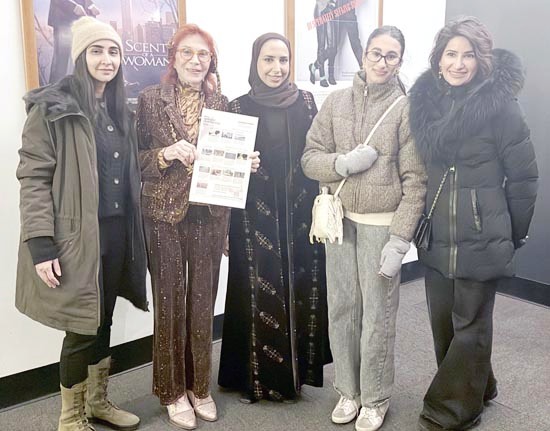
Film festival
attendee friend of Aljawhara Noura AlSabeg, Dr. Judy
Kuriansky (holding the film festival brochure), Aljawhara
AlHedfa and her friends, high school student May Al Fozan
and her mom Lama Al Hammad |
|
|
|
“I cried,” said Lama Al Hammad, an educational consultant
working on her doctorate in education at St. John’s
University, explaining that many Syrians live in her native
country of Saudi Arabia. “But,” as she told me with tears in
her eyes, “for the first time seeing this film, I realized
the depth of the pain they feel.”
Aljawhara and her younger brother Salem
overlap in their concern about international affairs and
social justice. It was Salem who introduced me to his sister
Aljawhara, knowing my past experience as a feature news
reporter and talk show host for various media outlets,
including CNBC, WCBS-TV and Z100, and producer of
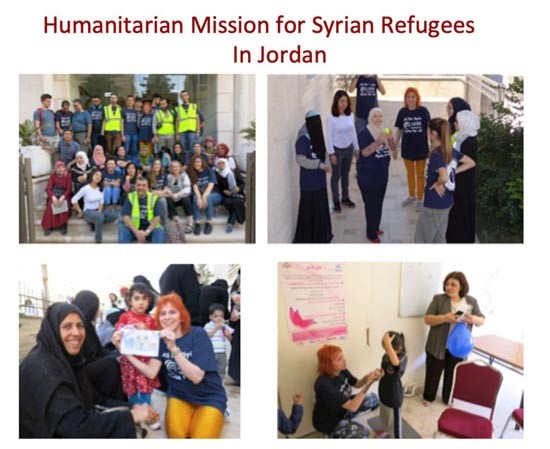
short films about my work conducting disaster recovery
workshops worldwide from Haiti and China to Iran, and even
participating in a mission to help Syrian refugees,
especially children, in Jordan. That work is published in
the Journal of Infant, Child, and Adolescent
Psychotherapy, about “A model psychosocial support
training and workshop during a medical mission for Syrian
refugee children in Jordan:
Techniques, lessons learned and recommendations”. See
https://doi.org/10.1080/15289168.2019.1690925 |
|
|
 |
|
Salem is the youth
delegate of Qatar in the Ministry of Sports and Youth who
was in New York City for the United Nations’ Commission for
Social Development (CSD), the timing of which coincided
perfectly with his sister’s film debut and to help her move.
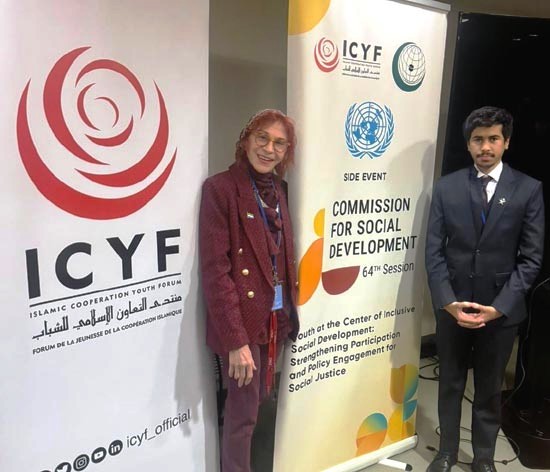
Salem and I attended a session the day before the screening,
entitled, “Youth at the Center of Inclusive Development:
Strengthening the Participation and Policy Engagement for
Social Justice.” Sponsored by the Islamic Cooperation Youth
Forum, the event highlighted youth projects integrating
technology into social development and inclusion, to fulfill
the Doha Political Declaration for Social Development agreed
upon at the Second World Social Development Summit in Doha
last November. |
|
|
 |
|
Dr. Judy
Kuriansky and Salem AlHedfa at the UN event |
|
|
|
Salem and I, along
with my colleague Zeever Baqar had met in Doha at the recent
Second Commission on Social Development Summit held in Doha,
and are now planning programs about youth, technology and
mental health. |
|
|
 |
|
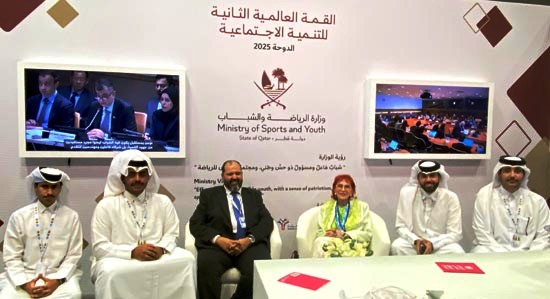
Members of the
Qatar Ministry of Sports and Youth with Dr. Judy Kuriansky
(middle) and Salem AlHedfa (far left) at the Second World
Social Development Summit in Doha, Qatar in November, 2025. |
|
|
|
After seeing the
film, Zeever commented, "This documentary is a deeply moving
testament to the invisible scars of forced exile. Beyond the
physical displacement, it speaks about the psychological
toll-the fractured sense of self, the grief of lost
identity, and the agonizing feeling of being suspended
between two or more worlds, fully belonging to neither. It
is a story that speaks for the 42.5 million refugees who
carry this burden every day." |
|
|
 |
|
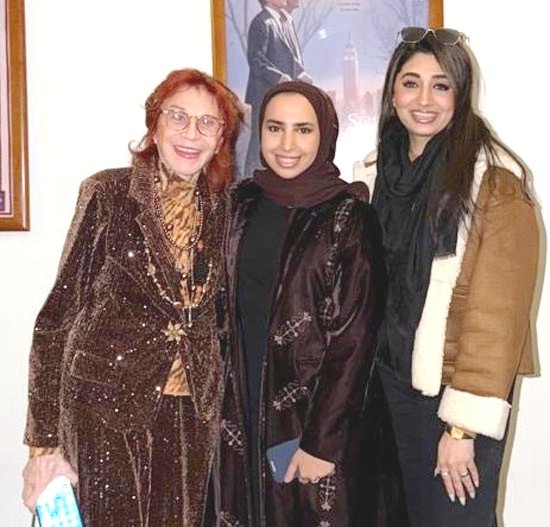
Dr. Judy
Kuriansky, Aljawhara AlHedfa and Zeever Bakar |
|
|
Beaming like a proud
papa, Aljawhara’s dad summed up watching the film,
“It’s like my daughter’s name, which translates into the word ‘jewel’.”
|
|
|

|
Bookmark Dr. Judy's Column on Black Tie International
Magazine
https://blacktiemagazine.com/Judy_Kuriansky/Judy_Kuriansky_Main_page.htm
|
|
|
|
|
| |
|
|
Back To Society News |
|
| |
|