|
Dr.
Judy Kuriansky |
|
Share this page with your friends |
|
|
www.blacktiemagazine.com
Dr. Judy Kuriansky:
Every Brilliant Thing
|
 |
Dr. Judy Kuriansky
Black Tie
International Magazine: Every Brilliant Thing play |
|
Surviving depression
and suicide:
A Broadway show’s lessons |
|
|
“Ice cream” “A
much-needed sneeze” “Really good oranges”.
These are reminders of things that make life worthwhile in
the face of severe mental suffering, as asserted on post-it
notes by the solo character in the currently-running
Broadway play in the eponymous
“Every Brilliant Thing.”
Like the main character, can you list a million things that
make life worth living?
That’s ultimately the number that actor Mariska Hargitay
comes up with over the 90 minutes of the solo play, as her
character traces her life from teenagerhood to adulthood,
struggling to make sense of her mother’s chronic depression,
and of life. |
|
|
 |
|
|
The subject matter
is right up the alley of a psychologist like me, familiar
from hearing hundreds of thousands of sad stories and
giving advice on public media.
Who hasn’t heard well-intentioned messages like, “The sun
will come up tomorrow” and “Things always get better” that
can fall on deaf depressed ears.
In a limited run until July7, Hargitay took over from
Tony-award winning actor Daniel Radcliffe (Merrily We Roll
Along, in 2024), who drew an appreciative audience. |
|
|
 |
|
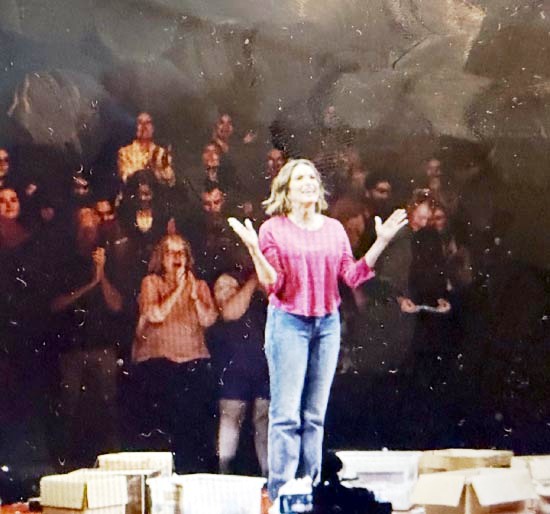
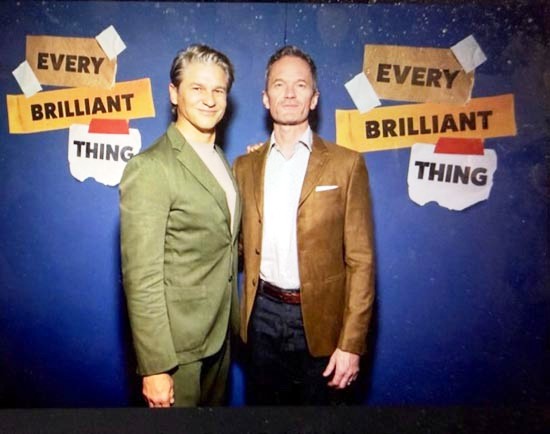
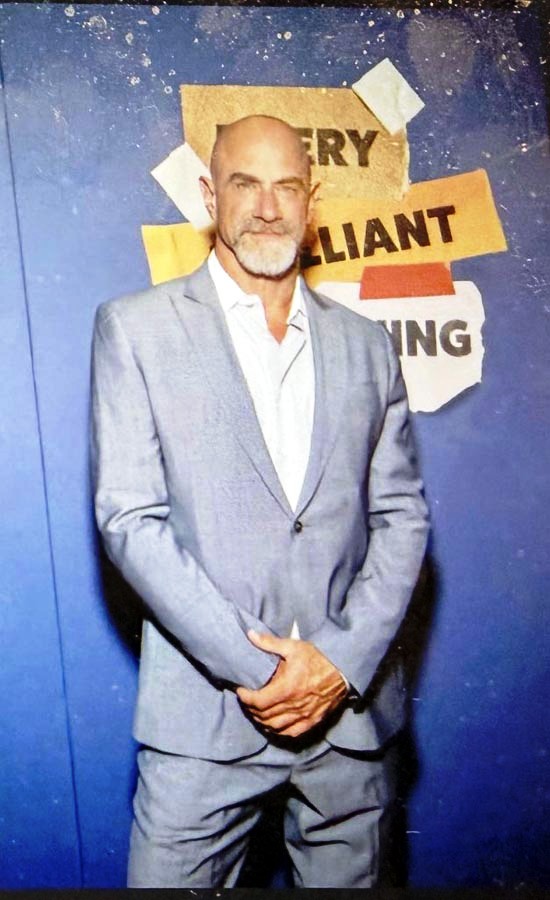
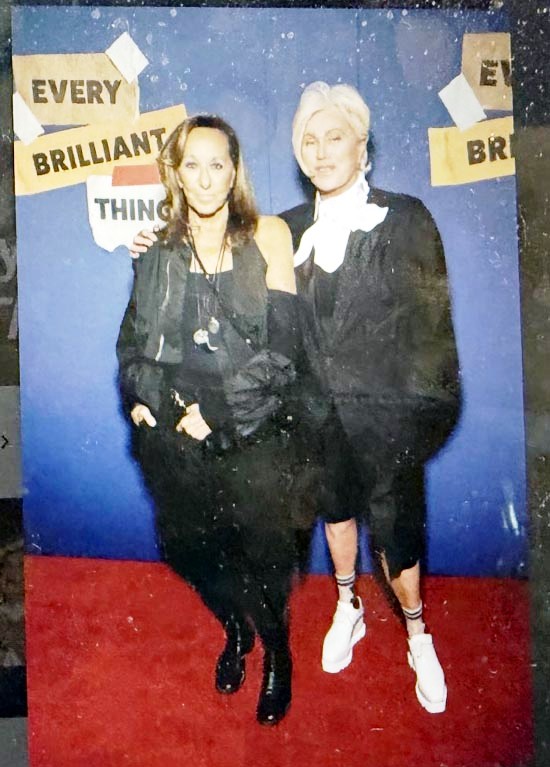
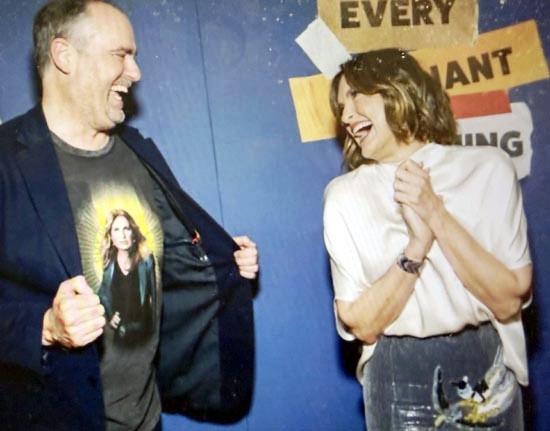
Stars turned out for
Mariska’s opening night on June 2nd. |
|
|
 |
|
Neil Patrick Harris
and David Burkha (Shawn Salley) |
|
|
 |
|
Christopher
Maloni (Shawn Salley) |
|
|
 |
|
Donna Karan and Hugh
Jackson ex-Deborra-Lee Furness (Shawn Salley) |
|
|
 |
|
(Shawn
Salley) |
|
|
|
A large fan base
follows Hargitay from her 25 years as Captain Olivia Benson
in Law & Order: SVU (Special Victims Unit), being the
longest-running female character in a primetime TV
live-action series, tackling troubling topics of sexual
abuse, domestic violence, trafficking, elder abuse and child
sexual abuse. The daughter of actress Jayne Mansfield (known
as a sex symbol), Hargitay is tough as her TV series
character cracking crimes, but known as kind in real life.
Traumas of all kinds have similar features. And, actors
always draw from personal experiences. So, one can say that
Hargitay’s outstanding and realistic performance in the play
draws from not only her TV character but also from being a
rape survivor and now a certified rape counselor in real
life. She also founded the Joyful Heart Foundation in 2004,
to support abuse survivors. Techniques include yoga,
journaling, and swimming with dolphins.
Stretches of monologue are interspersed with “breaks in the
fourth wall," where Hargitay interacts with people who are
seated on stage and recruited to play the roles of teacher,
love partner, or father, or when voices from the audience reading
items from the “list.” On my night, veteran TV reporter Karie Couric was called up from the audience to play a role
as a professor. |
|
|
 |
|
Marika
Hargitay and TV newscaster Katie Couric (Broadway World)
|
|
|
Hargitay’s energy
throughout the solo play is impressive (it helps that there
are no costume changes; she remains dressed in dungarees, a
red shirt and sneakers). As the narrator, she commands
throughout, even running around the audience at one point,
and returning onstage slightly winded, admitting as an aside
that she is 62 years old.
The show certainly reflects the shockingly high statistics
about the high rate of depression in real life, ranking as a leading cause
of death for youth and young adults. In dealing with such
pain, not surprisingly, the reactions of some audience
members ranged from, “It was too painful to watch,” and “I
got bored after the 1,000th entry,” to “It reminded me of my
own depression but I felt better watching it” and “I like
the reminder to remember all good things.”
Regardless of response, something is resonating even
worldwide, as the play was a hit in London’s West End and
has been performed in 80 countries in dozens of languages.
Good news for investors: the Broadway play already recouped
its production costs, helped by a low-cost capitalization.
On Broadway these days, crowds turn out to see stars close
up, regardless of the vehicle. Fans flocked to see George
Clooney in Good Night, Good Luck; Samual L. Jackson and
Jake Gyllenthal in the high-brow Shakespearean Othell (even paying up to $900 a ticket); Keanu Reeves in the
quizzical Waiting for Godot despite the existential
futility and suicide references; and Nathan Lane in Death
of a Salesman.
More reasons on the post-it notes to affirm life: “The color
yellow”
“Sex” “Old people holding hands”.
I certainly am very familiar with the drastic public health
problem portrayed, in my role as a psychologist and in the
public arena on multimedia for decades. For example, the
audience participation creating a “communal experience”
makes sense, since psychological research – and my own first
responder work worldwide -- shows that connection with
others is critical to recovery.
As a psychologist, I was particularly sensitive to whether
the lines, actions, and messages were professionally valid.
Glad to say, most were. Sadly, her marriage sadly falls
apart, but that’s not unusual about what happens in real
life.
The three lessons I always say from my years of hearing
people’s problems over decades as a radio advice host:
you’re not alone, value all your feelings, and there is
always help and hope.
The play tells us: you’re not alone; nothing you feel is
weird; and hold on. Take refuge and pleasure in every small,
beautiful thing. It warns about what is futile and does not
work: trying to “fix” someone or figure it out (the father
character persistently asks “Why?), or giving others
frivolous advice that things will get better (which is a bit
contradictory to the show’s message or the truth (since there is an
appropriate
time for that reminder).
Journaling is an increasingly popular way to process
troubles. Apparently, writing this play was an effort by
playwright Duncan Macmillan to help himself cope with his
own mental health challenges (besides being a vehicle for a
friend actress to have stage time). |
|
|
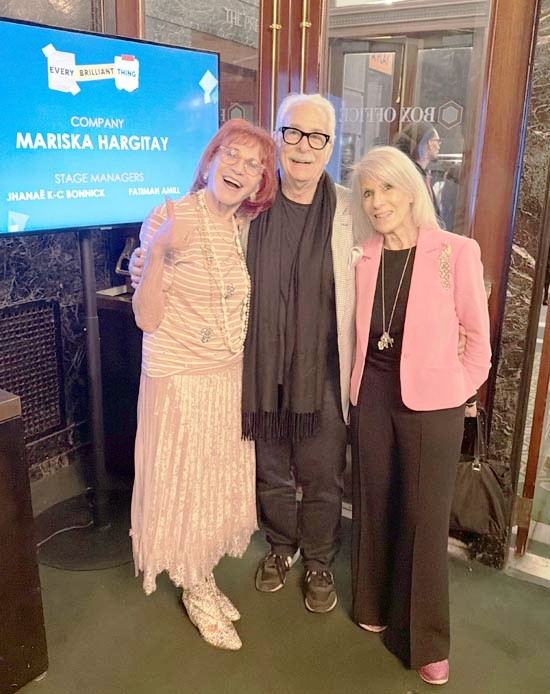 |
In the theatre
lobby, Dr. Judy Kuriansky with theatre producer friends
Jamie De Roy and Richard Winkler |
|
|
The last reassurance
in the play rings out in the theatre with the feel-good 1970
hit song, "O-o-h Child, things are going to get easier."
Hope reigns supreme. Like the song my music partner and I
wrote in the midst of people dying from the ravaging
pandemic of Ebola in West Africa, despite the worst of
circumstances (and that people sang back to me when I
returned to the region): “Hope is Alive.” |
|
|
 |
|
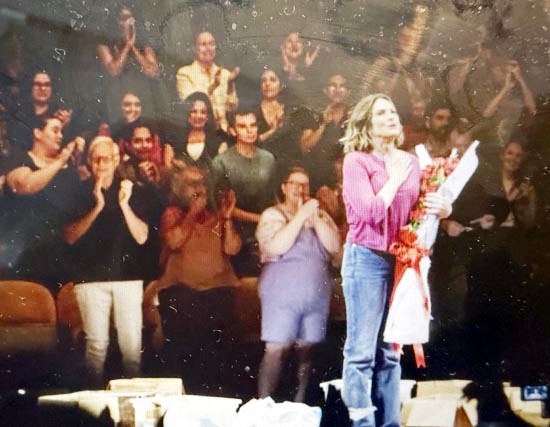
Diana Ross’
daughter, 53-year-old Tracee Ellis Ross, 6-time Emmy Award
nominee and Golden Globe winner, takes over for 40
performances starting from July 7. She’s bound to carry on
the appeal. |
|
|
|
|
|
Bookmark Dr. Judy's Column on Black Tie International
Magazine
https://blacktiemagazine.com/Judy_Kuriansky/Judy_Kuriansky_Main_page.htm
|
|
|
| |
|
| |
|