Black Tie
International Magazine China 1
2 3
4
www.blacktiechina.com
|
|
Share this page with your friends |
|
|
www.blacktiemagazine.com
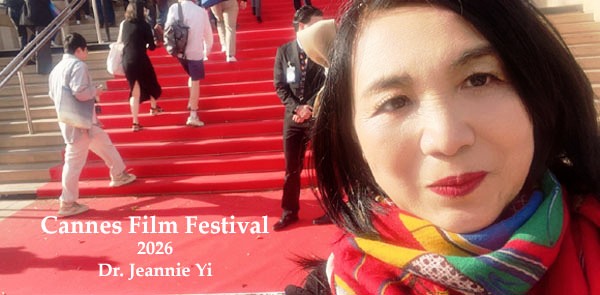
Cannes Film Festival - Dr Jeannie Yi
|
 |
|
Dr. Jeannie Yi |
|
|
|
Cannes Film Festival 2026
A series of special reports by
Dr. Jeannie Yi |
|
|
 |
|
|
Andy Garcia’s - Diamond
By Dr. Jeannie Yi |
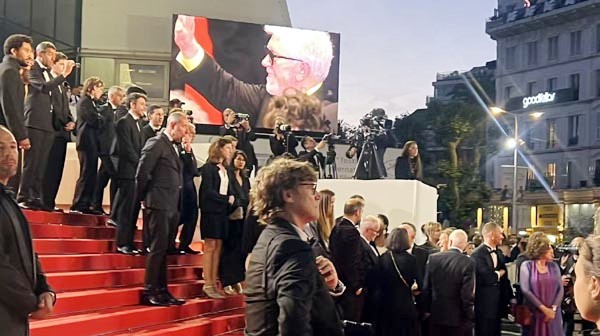
Yesterday’s emotional climax — and
perhaps the moment that moved me most
deeply — belonged to Andy Garcia and his
film Diamond.
Anyone who loves cinema probably knows
Andy Garcia from The Godfather Part III,
for which he received an Academy Award
nomination for Best Supporting Actor in
1990. From that moment on, he became one
of Hollywood’s most celebrated stars,
and many of the films he appeared in
went on to become major box office
successes.
Diamond is an artistically powerful film
in which Andy Garcia not only stars, but
also serves as director.
At first, the movie appears to be a
detective story.
A man investigating crimes.
A man hiding inside another identity.
A man pretending to be someone else,
moving and speaking as if he has
absolutely nothing to do with the modern
world around him.
One unforgettable line in the film asks:
“What is a selfie?”
He pretends to be somebody else living
in another time
— another era, a vanished past.
But as the story slowly unfolds, the
audience begins to realize:
he is not escaping the world.
He is escaping himself.
Or more precisely, he is escaping an
unbearable grief and pain:
he could not save his son, who died from
illness years earlier.
For twelve years, he has emotionally and
psychologically disguised himself as
another person, carrying guilt like a
second skin.
Meanwhile, his wife has never stopped
waiting for him.
She is not simply waiting for him to
come home physically.
She is waiting for him to become himself
again.
There is another woman in the film whose
husband has been murdered, yet she
herself becomes accused of the crime.
Another couple in the story has also
lost a son.
Every character in the film carries deep
wounds.
Every person is burdened by a sorrow
they cannot escape.
And yet, by the end, they are all
somehow “cleared.”
Not because life suddenly becomes
perfect.
But because truth finally rises to the
surface.
When Andy Garcia stood up after the
screening, his eyes were visibly wet.
The entire theater erupted into a
massive standing ovation.
Thousands of people rose to their feet
and applauded
for a full nine minutes.
People were not only applauding the film
itself.
They were applauding its emotional
honesty.
And in that moment, I suddenly
understood something:
why people love cinema almost
religiously.
Why stars and directors leave such deep
imprints on human memory.
Why The Godfather continues to resonate
across generations decades later.
Because great films allow people to
publicly mourn the pain
they have privately hidden their entire
lives. |
|
|
 |
What Should Filmmakers Do
When Great Powers Meet?
A Moment at Saturday Lunch During the
Cannes Film Festival
By Dr. Jeannie Yi
New York Jinsheng
Today is my third day at the Cannes Film
Festival. It is also the first day I
truly saw the power of the American film
industry
— and the entire ecosystem of Cannes
itself.
I used to think of Cannes as a European
film festival: a sanctuary for art
cinema, a paradise for avant-garde
directors. But after walking through the
three floors of the festival hall,
sitting by the sea among the massive
film advertisements, moving between the
Majestic Hotel, the Eden Theater,
screenings, markets, meetings, and the
cafés and hotels full of Southern French
charm, I suddenly realized that the
power of the American film industry is
far beyond what most people imagine.
Of course, Cannes is enchanting.
The sea breeze, the sunlight, the French
Riviera, beautiful women, handsome men,
red carpets, champagne, and stunning
movie posters
— the whole city feels like a grand
stage of youth and desire.
Everyone looks beautiful. Everyone makes
your heart beat faster. Young women wear
almost nothing, oversized sunglasses on
their faces, high heels under their
feet, like walking cinema. Young men
dress like movie stars, mostly in white
shirts. Every café is full, filled with
pleasure, bright smiles, and stories
floating in the air.
You feel that all the people in the
world who know how to dream have
gathered here.
But when I truly observed the film
market, I suddenly discovered that the
underlying structure of Cannes is still
deeply occupied by the American film
industry. More than half of the
important voices, distribution channels,
platforms, capital, and narrative power
— including so many action-driven films
full of conflict and violence — come
from America.
America occupies so much space that when
you walk in, you almost feel you have
returned to the American Film Market in
Hollywood
in November.
What remains belongs to China, Japan,
Korea, Thailand, Latin America, France,
Britain, and others. Even many European
countries have a very limited presence.
Their movie posters are small. And then
you suddenly realize: America’s true
power is not only military or economic.
It is its ability to shape imagination.
Hollywood’s greatest power is that it
teaches the world to understand love,
success, heroism, family, government,
freedom, individuality, separation, and
even death — in an American way.
After walking around, I also saw that
China is now treating storytelling as a
form of national power. China, Japan,
Korea, and Thailand are all aggressively
entering film, entertainment, and
streaming. But their space and
visibility still look very small.
At noon, in the lobby of one of the most
luxurious hotels by the sea — the
Majestic — filmmakers from all over the
world filled the hall. More than five
hundred directors, writers, producers,
and actors were discussing screenplay
structure, financing plans, AI,
distribution, streaming, and the global
market.
But my question was more specific:
How can the dead truly “come back”?
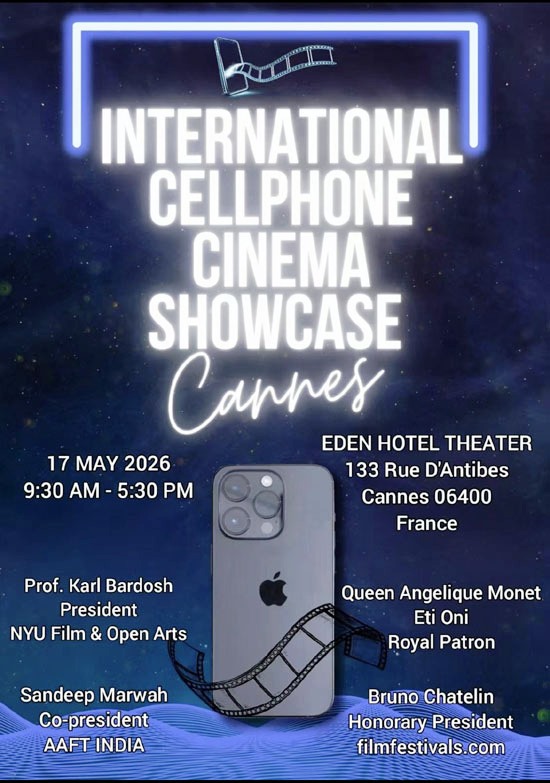
As arranged the night before, I sat down
for lunch with Professor Karl Bardosh,
an old professor from NYU Tisch School
of the Arts. After speaking with him, I
felt even more deeply that the strength
of the American film industry is no
accident.
Behind it is a complete system: film
schools, screenplay structure, agents,
studios, financing, distribution, global
language advantage, streaming platforms,
and audience training.
Most importantly, Hollywood understands
human desire.
It knows why people cry. Why they love.
Why they are lonely.
Why they want to become someone else.
And it does not merely tell you this —
it shows you, through images.
A new scene every three seconds.
I know this because my daughter
graduated from NYU Tisch as an
undergraduate, and she is also a strong
storyteller.
Professor Karl said that my film Main
Street stands in a very delicate
position. It is neither a purely
American story nor a purely Chinese
story.
It is a Chinese American story.
It asks: standing between two great
powers, how should we live — especially
our second-generation Chinese Americans?
Perhaps for this reason, although
Professor Karl was extremely busy, he
was willing to make time for me and for
my film Main Street.
I told him that the real wound in Main
Street is not immigration, poverty, or
cultural conflict.
It is the absence of closure.
In Chinese, we say: to begin well and
end well.
In my story, the three mothers were
still very young girls when they left
China — almost still minors. They left
their parents and homeland with
fantasies about the future, longing for
America, and desires for money, love,
and success.
But later, they became busy surviving,
busy working, busy marrying foreigners
casually for green cards, busy becoming
mothers.
By the time they finally looked back,
their parents had grown old
— or were already gone.
And so a black hole remained in their
lives forever.
What do you do when there is a hole in
your heart?
They never had the chance to apologize
to the past, or to say,
“Actually, I have missed you all along.”
So they placed all of this onto their
daughters, and also onto those who
walked the same road with them.
Control. Anxiety. Sacrifice. Endless
complaints.
Because grief had no exit.
I did not know how this film should end.
Because how do you meet the dead again?
How do you apologize?
Professor Karl said, “Technology has
already changed the relationship between
human beings and memory. In the past, we
could not be in two places at once,
because the body could not be separated
from our thoughts, emotions, and spirit.
Once the body disappeared, everything
ended. But today, avatars, AI, digital
memory, voice reconstruction, and dream
imagery have allowed the absent to
continue existing
in our emotional reality.”
“If a person has left behind voice,
image, language, writing, and memory
traces, then in a certain sense, they
have not truly disappeared.”
“Wasn’t Obama recently appearing in two
places at once for interviews?”
Then it came to me.
The ending of Main Street could allow
the living to have a face-to-face
conversation with the past — to be
present again.
Perhaps in a dream. Perhaps through AI
reconstruction. Perhaps through a memory
ritual. Perhaps in a late-night kitchen,
listening to a familiar voice, when the
image of a long-lost loved one returns.
Wouldn’t the black hole in the heart
then be surrounded and filled by
boundless forgiveness and love?
They could finally say the words they
never said.
Cry the tears they never cried.
Complete the ritual they never
completed.
Professor Karl used a very important
phrase:
“To air their grief so they can unburden
and move on.”
In other words, only when people truly
release their grief can they move
forward lightly, with love and
gratitude.
The true ending of Main Street is not
reunion.
It is reconciliation.
It is mutual understanding.
It is finishing the sentence that never
had a chance to be finished.
It allows the living to follow the road
back, return to the original place,
forgive the past — and forgive
themselves.
Professor Karl Bardosh solved the
biggest problem in Main Street for me.
At that very moment, a piece of news
suddenly arrived: Chinese President Xi
Jinping and U.S. President Donald Trump
were continuing their meeting in
Beijing.
Sitting across from me, Professor Karl
Bardosh
suddenly stopped our discussion.
He said:
“Stop. This is the most important story
right now.”
He said, “The greatest responsibility of
filmmakers is to reflect the deepest
human desire.”
Then he paused and said:
“Today, the most important desire in the
world is peace. The greater the nation,
the greater the responsibility. And the
storyteller is the same. Because nations
decide trade, war, resources, and order.
But storytellers decide how human beings
understand one another.”
I said yes.
This morning, sitting under the sunlight
of the French Riviera, fifty dollars
could only buy two omelets and two small
cups of coffee.
How are ordinary people supposed to
live?
They cannot solve inflation, rent,
healthcare, energy, or trade wars.
They can only hand these problems over
to government.
And governments must constantly seek
balance among trade, national interest,
public emotion, and world order.
So, the professor said, when two
superpowers meet, they are not merely
discussing politics. They are discussing
whether the world can still maintain
some form of stability.
What ordinary people truly care about is
this:
If there is no stability, how do we
live?
Between husband and wife.
Between parents and children.
Between Chinese and Americans.
Between immigrants and the homeland.
Professor Karl added:
“The greatest danger for humanity is not
disagreement. It is choosing not to
understand one another. Because
understanding is very difficult. It
requires us to change our own point of
view.”
He said:
“To build a house may take two years.
But to destroy it may take only two
hours. One bomb.”
I thought he was absolutely right.
This is true of nations.
It is also true of families.
And it is even more true between human
beings.
A hurtful sentence may take only a few
seconds to say.
But repairing it may take a lifetime.
Then the professor said,
“Now do you understand why cinema is so
important?”
Because the greatness of cinema is not
that it allows us to escape into distant
places or endless fantasy.
Cinema trains human beings to enter
another person’s inner world again.
It allows us to see another person’s
pain, another person’s loneliness, why
another person is angry, why another
person is afraid.
And then hatred begins to loosen.
I looked at the professor.
He came from Europe. He experienced the
Cold War, displacement, and endless
arguments caused by different worldviews
and beliefs.
Later, he came to New York and taught
film for more than thirty years at NYU
Tisch School of the Arts.
Today, at seventy-five, he is still
carrying his own projector through the
Cannes Film Festival, promoting Cell
Phone Cinema.
He said:
“Every person now carries a movie studio
in their pocket.”
At the end of lunch, I suddenly
understood the Chinese saying:
“A teacher for one day is a father for
life.”
Professor Karl is exactly that kind of
teacher.
“Prepare your video screening for
tomorrow,” the professor said as he
stood up, carefully placing his computer
into his bag.
Just moments earlier, he had watched me
save the trailer and story materials for
Main Street onto both his computer and
his phone.
“Tomorrow, Main Street TV will be shown
at the Cannes Film Festival. Do you know
why?”
I said:
“To tell the Chinese American story
well.” |
|
|
 |
|
|
Time After Time — After Tangle
What really matters in Cannes is
a good movie!
By Dr. Jeannie Yi
Cannes Film Festival, May 2026
Last night in Cannes was filled with
champagne, music, sea wind, sequins,
temporary encounters, and the endless
movement of beautiful people beneath
colorful blinking lights.
This morning, all of that suddenly felt
very small and non-consequential,
because I walked into an animated film
called Tangle.
And for two hours, nobody in the theater
moved. People cried quietly beside me.
The two girls with bobbed hate silently
dabbed at their eyes. When the film
ended, nobody stood up. Nobody rushed
out. The applause came softly, almost
reluctantly, as if people needed a few
more seconds to return to their own
lives.
That is when you know cinema has touched
something real. And you know what good
movies are still showing at film feast
half and cinemas.
At first glance, the story seems simple:
a family of four,two daughters, a father
who teaches literature,a mother who once
taught high school.An educated family.
A loving family.
But slowly the film reveals itself to be
about the hardest subjects in
life:aging,separation,
memory loss,migration,love, and death.
The eldest daughter, Sarah, is an artist
living between New York and San
Francisco. She falls in love with
another woman, but her life becomes
divided because her mother is slowly
disappearing into Alzheimer’s.She
travels constantly between caregiving
and her own unfinished life.
Then comes one of the most heartbreaking
lines in the film. Her girlfriend tells
her:
“I want to fall in love with the whole
of you, not half of you.”
Not because she does not love Sarah —
but because illness fractures entire
families.
Sarah is emotionally split between duty
and desire, between art and
responsibility, between staying and
leaving. The line is devastating because
every adult eventually understands it:
sometimes love is not lost,
only divided.
Then there is another moment I will
never forget and another powerful line.
The mother falls from the bed. And the
father quietly says: “I should be the
bed railing.”
Not “I should save her.”Not “I should
die instead.”
But: “I should be the railing.”
Protection.
That may be one of the purest
definitions of love I have ever heard.
When people grow old together, love
changes form. It is no longer dramatic
and fury. It becomes practical
tenderness: holding someone
steady,preventing the fall,becoming the
small thing standing between the person
you love and the hard floor of reality.
The third devastating detail involves
the family cat. The cat dies. But the
mother no longer remembers this because
her memory has faded so deeply. So the
family quietly replaces the cat with
another one for her.
Only Sarah, the artist daughter, fully
understands the emotional truth of what
happened, comforts through small
mercies,
small substitutions, small acts of
protection.
Not lies. Love.
And then comes the ending beneath the
cypress trees. A cypress leaf falls to
the frozen ground and becomes trapped
inside ice.The young Sarah says: “I want
to be like the maple leaf.”And the
mother answers: “One day, we can all be
maple leaves.”Maple leaves become most
beautiful at the moment they let go, the
colorful radiance before disappearance.
The line is not about death, it is about
transformation.
About seasons. About accepting that life
itself is temporary, and therefore
precious, so are loving memories.
As I watched this film, memories I had
not touched in years suddenly returned
to me.
I thought about my daughter Blair at New
York University Tisch School of the Arts
and her own animation graduation film.
Her story was also about wind, a
destructive tornado and her family.
A tiny tornado born weakest among nine
siblings, too small to keep up and
always falling behind the stronger
storms of her siblings who try to catch
up and become their Mother, the Storm
Cloud that destroys along the way.
But in the end, instead of becoming more
destructive, although tried as she has,
the little tornado chooses another path.
She becomes a gentle breeze.
She restores the giant trees stripped
bare by the Storms ahead of her; Returns
bird nests to branches. Pushes stranded
tadpoles gently back toward the water.
Heals what violence had damaged.
I remember thinking then: what kind of
young artist chooses healing over power?
Does she learn that survival of the
fittest?
And today, sitting inside this theater
in Cannes, I suddenly understood.
Yes, Animation can hold grief in ways
realism sometimes cannot. Drawings
soften pain just enough for us to
approach it and appreciates true love
just as much. A cat, a leaf, a railing,
a frozen tree,
a goodbye not fully spoken.
The film also brought back another
memory:
my husband receiving his notice to come
to America at almost the same moment his
father received the diagnosis of
terminal cancer. To leave toward a
future while someone you love moves
toward death.
What kind of choice is that for a son?
People see arrival. Degrees. Careers.New
lives. Success. But behind so many
journeys is an invisible grief: the
parent left behind, the funeral missed,
the unspoken good bye and the guilt of
surviving forward.
And suddenly, sitting in the dark of the
theater among sobbing, everything else
gives way. The champagne from last
night.
The luxury suites. The flirtations.The
fantasy of one-night encounters.The
endless conversations about money,
fashion, influence,
success and visibility.
All of it fades before a truly great
story, a truly great movie!
That is why movie theaters still exist.
That is why cinema still matters. Not
because of technology. Not because of
format.
Not because something is animated,
AI-assisted, live action, virtual,
independent, or made by a major studio.
None of that is the heart of cinema.The
heart is emotion.The heart is whether
human beings sit together in darkness
and suddenly remember what it means to
love, to lose, to leave, to forgive, and
to continue living, because only great
storytelling moves the soul.
I have attended many screenings,
premieres, and festivals over the years.
But this one stayed. Because when the
music ended, nobody moved. Everyone was
holding onto someone —their mother,
their daughter, their father, their
unfinished goodbye —for just a few
seconds longer.
And perhaps that is the greatest
achievement cinema can still accomplish:
helping us make sense time after time!
|
|
|
 |
|
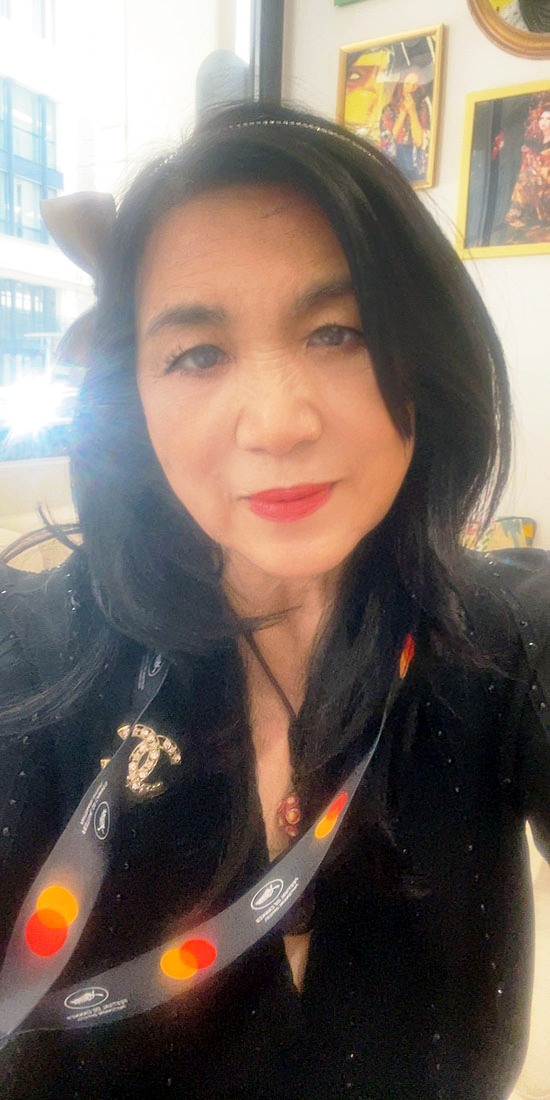
Dr. Jeannie Yi |
Three Days to Love
in a world of China Red, White Gold,
and Black Chic, life blooms …
By Dr. Jeannie Yi
Cannes Film Festival
Sometimes a city does not reveal itself
through architecture.
Sometimes it reveals itself through
colors.
Like now.
Cannes, to me, became three colors.
China red.
White gold.
Black chic.
And somewhere between those three
colors, I began to understand not only
Cannes —
but perhaps my own life, painted again
and again upon a canvas dominated by
these colors.
⸻
The first color was red.
Not aggressive red.
Not loud red.
China red.
Lipstick beneath hotel lights.
Silk falling from bare shoulders beside
the Mediterranean.
Old lacquer glowing softly in darkness.
The red of Yongzheng’s 红碗.
That red followed me downstairs last
night.
Into the lobby.
Into the lounge.
Out toward the carpet beside the sea.
And suddenly Cannes opened.
Sequins.
Champagne.
Cameras.
Desire.
Temporary intimacies.
And China red everywhere.
Hands touching briefly.
Kisses disappearing into sea wind.
Names exchanged that may never be spoken
again after the festival ends.
And then I looked up.
A beautiful couple on a banner.
And suddenly I thought of The Great
Gatsby.
Because Cannes feels strangely close to
Gatsby.
Not New York Gatsby.
Emotional Gatsby.
A world built from longing, light,
performance, and impossible hope.
And of course, Leonardo DiCaprio
understood this perfectly.
The elegance beneath loneliness.
The hunger beneath glamour.
The belief that one perfect moment might
stop time.
But Gatsby’s love never lasts.
Perhaps that is why people say Gatsby
was killed by hope —
mistaking a fleeting moment for a
lifetime.
And Daisy herself belongs only to
luminous nights.
Like Cannes.
Beautiful things are sometimes not built
to last.
They are built to illuminate.
And perhaps that is why China red
matters so much emotionally.
Especially Yongzheng red.
His reign lasted only thirteen years.
No comparison with Qianlong in scale or
quantity.
Qianlong filled the empire with endless
porcelain.
But Yongzheng set the standard.
Restrained red.
Disciplined red.
Red perfected through pressure and fire.
Not abundance.
Precision.
Control.
Without control, porcelain breaks.
And perhaps human beings are the same.
That is China red.
Passion refined through tempering.
Endurance.
Maybe even unfulfilled longing.
⸻
Then came the second color.
White gold.
Seven o’clock in the morning.
The lobby of Carlton Cannes, a Regent
Hotel still quiet before breakfast
service begins.
White marble columns.
Golden chandeliers.
Soft morning light.
And everywhere — white peonies.
White peonies and lilacs resting against
glowing gold walls resembling scales of
light.
And suddenly the flowers were no longer
decoration.
They became memory.
The flowers I grew up with.
Not roses.
Not orchids.
Peonies.
Flowers from another life.
Another China.
Another childhood.
A childhood where I threw myself onto
the grass and listened to it grow.
Tiny popping sounds.
As if every blade of grass were
breathing softly beneath the stars.
Above me — galaxies blinking with
temptation.
Asking me to fly somewhere far beyond
the known world.
And suddenly, at seven o’clock in the
morning, the Carlton was no longer
simply a luxury hotel on the French
Riviera.
It became a meeting place between old
Chengdu and Hollywood.
Between childhood tenderness and adult
sophistication.
Between memory and performance.
And yet the gold walls still carried
Gatsby.
Wealth.
Illusion.
Summer light.
Temporary dreams.
Forever longing.
But the white flowers softened
everything.
They reminded me that beneath glamour,
human beings are fragile.
Some flowers fully opened.
Some still waiting.
Some already fading.
And perhaps that is why they felt so
alive.
So beautiful.
So enchanting.
⸻
Then finally came the third color.
Black chic.
Black sequins beneath low evening light.
Black fabric holding together all the
emotion of red and gold.
Black dignity after passion.
Without black, red becomes sentimental.
Without black, gold becomes excessive.
Western sophistication at its best is
not loud luxury.
It is controlled elegance.
And perhaps that is why Cannes feels
different from Hollywood.
Hollywood wants to shine.
Cannes wants to linger.
In Cannes, glamour still leaves room for
melancholy.
And maybe that is what I truly fell in
love with during these three days.
Not celebrity.
Not the red carpet.
Not even cinema itself.
But the strange beauty of temporary
illumination.
China red.
White gold.
Black chic.
Passion.
Memory.
Dignity.
Three colors.
Three days.
A lifetime of survival and celebration.
And somewhere between the Mediterranean
sea wind, the white peonies, Gatsby’s
longing, Yongzheng’s refinement, and
unfinished conversations drifting
through the hotel lobby, I suddenly
realized:
Some moments are not meant to become
permanent.
They are meant to be lived fully.
Then remembered beautifully.
Even if we are given only three days to
love.
And three days to truly live. |
|
|
 |
|
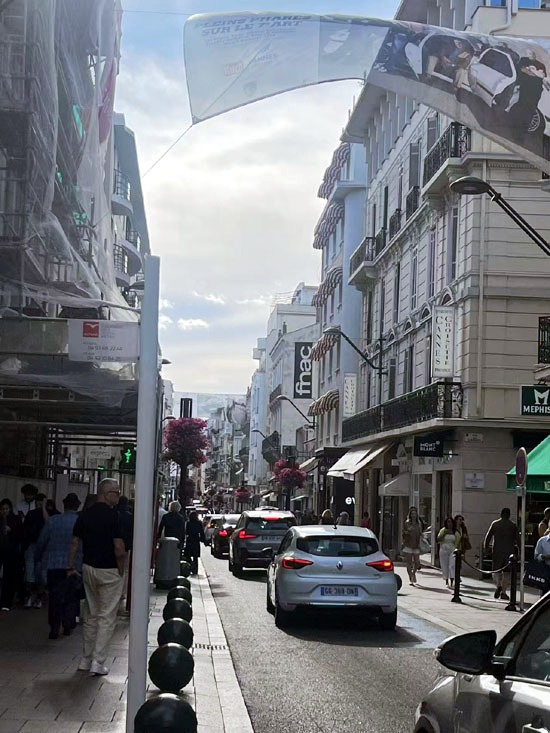
Cannes |
Cannes: A City Where People Are Allowed
to Shine
and Fall in Love
An Essay by Dr. Jeannie Yi
I flew from Newark to the south of
Europe.
When I arrived at the airport that
afternoon, my very first impression was
surprisingly simple: small.
The airport was tiny.
Quiet — almost too quiet for the gateway
to one of the world’s most famous film
festivals.
The scenery along the way brought me
back to an older China — to my Chengdu
before urbanization, before skyscrapers
and speed. Romantic, slow, and strangely
beautiful.
But then I arrived at the hotels.
Magnificent hotels stood side by side.
The streets suddenly became more
beautiful, more glamorous, more alive.
A city both romantic and fashionable
rose before me all at once, suddenly
becoming much bigger than itself.
The lobbies were dazzling, filled with
lights and movement.
Yet once inside the rooms, everything
became very small again.
Europe always seems to be like this.
Never too loud on the outside.
Because what truly matters is not space
— but the distance between people.
But the moment I truly began to
understand Cannes was when I walked to
the sea.
My hotel was only a few steps from the
beach.
And once I reached the water, the entire
world changed.
In that instant, you suddenly understand
why France is called the city of love.
The wind is soft.
The light is golden.
The crowds along the shore move like a
long cinematic tracking shot.
And Cannes, to me, has three layers of
beauty.
The first layer is the sea.
The Mediterranean itself feels like a
giant stage.
Yachts float on the water. Lights
shimmer across the waves. Wind travels
endlessly along the coastline.
People naturally slow down there.
Arms around shoulders.
Hands intertwined.
Kisses.
Laughter.
Bodies leaning into each other without
fear.
The second layer is the promenade.
That seaside walkway feels like a film
premiere that never ends.
It is as if filmmakers, actors,
producers, investors, and media from all
over the world all appear there at the
exact same moment, dressed in the finest
versions of themselves.
Some are taking photographs.
Some are hugging.
Some are discussing projects.
But more importantly, everyone seems to
be presenting the brightest version of
their own life.
This must be the culture of the red
carpet:
“I have finally arrived at the center of
the world.
I deserve to be seen.
I deserve to be cherished.”
The third layer is the hotel lobby.
Places like Hôtel Barričre Le Majestic
Cannes and Carlton Cannes, a Regent
Hotel are not truly about the rooms.
They are about the extraordinary
lobbies.
Everyone, dressed beautifully, gathers
there to network.
You sit down with a cocktail, and beside
you might be a director, an actor, an
investor — or perhaps the beginning of
the next film.
The entire atmosphere carries the flow
of the film industry itself.
Like a movie set.
Like endless camera cuts moving from one
story to another.
Tonight, I sat there with several
friends from Hollywood.
We drank.
We ate French fries.
And suddenly I had a very deep
realization:
My God… I am not here chasing something
anymore.
I am here to enjoy all of this.
After Family Film Awards on CBS.
After Saving the Ocean on CW.
After Main Street finding its way into
the hands of Hollywood filmmakers.
After walking so far and doing so much,
I finally arrived here.
And for the first time in a very long
time, I allowed myself to stop.
To glide without weight.
Watching the crowds beside the sea, I
suddenly thought:
Yes.
We all deserve this.
Not to prove anything.
Not to fight endlessly again.
We write.
We tell stories.
We turn objects into life itself.
We connect Hollywood with Chinese
values.
We ignite something in other people.
All the energy that comes from the mind,
the heart, and the body —
all the energy we constantly give away
throughout our lives —
somehow, tonight, returned to us again.
Returned through unfinished scripts.
Unmade films.
New thoughts forming.
New feelings.
New love.
And a future that suddenly feels close
enough to touch.
For once, it was enough simply to sit
there like a character inside a movie —
feeling the sea breeze, watching
thousands of lights flicker across the
night, holding a cocktail in my hand,
and quietly saying to myself:
I finally made it here.
The sea wind keeps blowing.
New people.
New stories.
The outline of a new city.
A new future.
This was my first night at the Cannes
Film Festival:
A city where people are allowed to
shine,
and allowed to fall in love.
A beautiful planet where miracles and
surprises still happen. |
|
|
|
|
| |
|
|
Back To Society News |
|
| |
|